


AI-Powered WhatsApp CRM: The future of sales automation
AI-powered WhatsApp CRM is transforming sales automation by turning WhatsApp conversations into structured, intelligent sales workflows. Discover how AI in CRM improves lead qualification, follow-ups, customer engagement, and pipeline visibility while helping sales teams close deals faster.

WhatsApp has quietly become one of the most important sales channels in many markets. It is the platform where prospects ask “quick questions,” share referrals, negotiate, and where follow-ups actually get read.
WhatsApp sits in a unique spot for businesses, that feels personal like a phone call, asynchronous like email, and far more responsive than traditional outreach.
The problem is that most sales businesses still treat WhatsApp as an informal channel that is often being managed on personal devices, disconnected from the CRM, and impossible to scale without chaos. The concept of an AI-powered WhatsApp CRM is gaining momentum because messages get lost, context disappears, response quality varies, and reporting becomes guesswork.
It brings WhatsApp into the formal sales system by capturing conversations, structuring lead intelligence, automating routine actions, and helping reps close deals faster. Combined with AI in CRM, it turns messaging from “just chat” into an intelligent sales engine.
Why WhatsApp is becoming the default sales surface
Sales communication has shifted. People expect fast responses, minimal friction, conversational tone, persistence of context, & mobile-first convenience. WhatsApp delivers all of that, and for many industries, it often outperforms email in open & response rates.
But without structure, WhatsApp creates operational risk:
- lead data is scattered across devices
- sales activity can’t be audited or measured
- handoffs between reps are messy
- managers lack pipeline visibility
- compliance and data retention are inconsistent
An AI WhatsApp CRM addresses these issues by connecting conversations to pipeline execution.
The AI layer: What AI in CRM changes
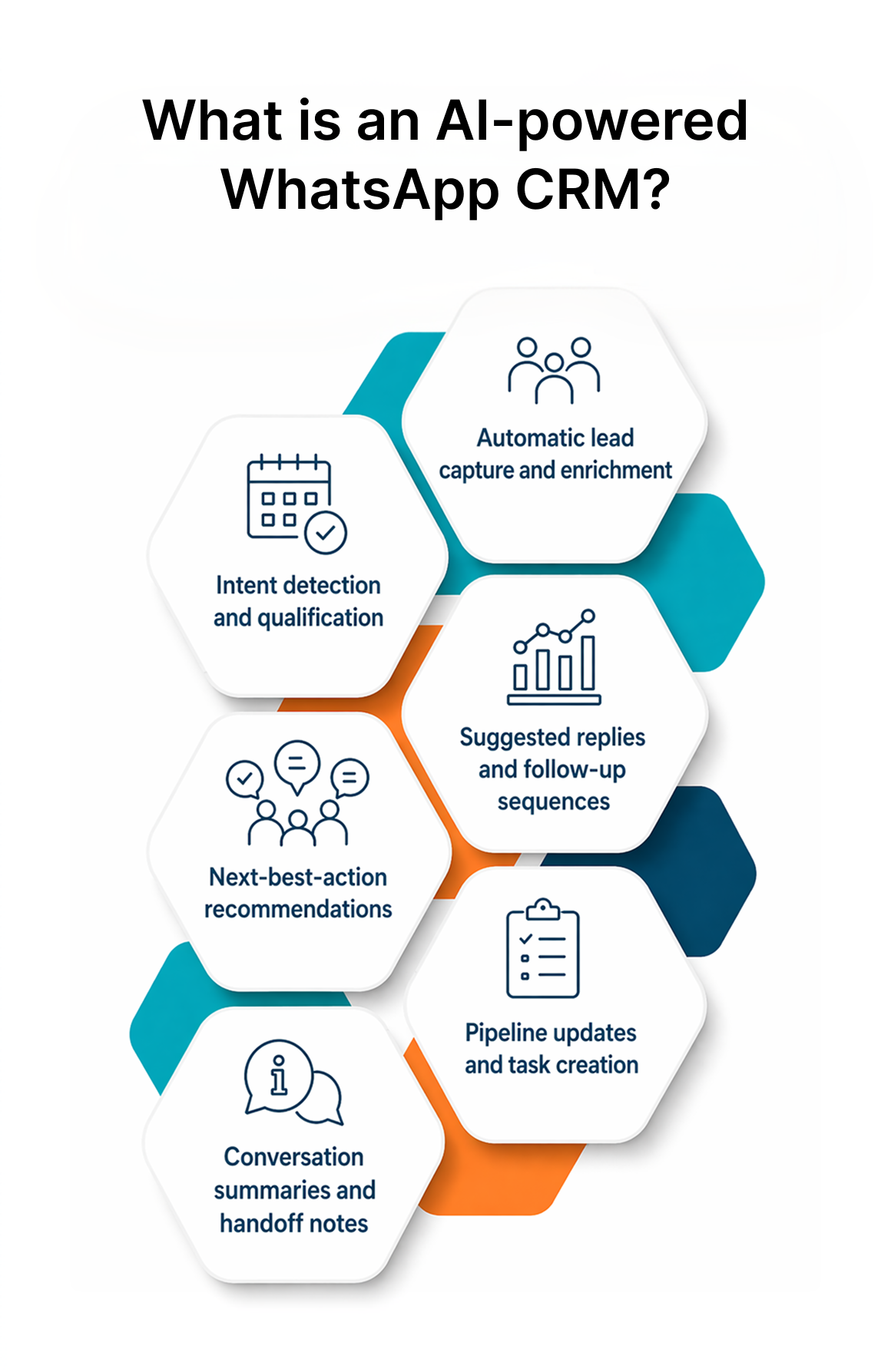
When people hear AI in CRM, they often think of chatbots. In modern sales automation, the most valuable AI capabilities are workflow-centric:
Conversation intelligence
AI can automatically detect lead intent, urgency, objections, decision stage cues, and sentiment and drop-off risk. This turns unstructured WhatsApp threads into structured pipeline signals.
Automated data capture and CRM hygiene
Sales efficiency collapses when reps don’t update CRM fields. AI can:
- Extract names, company details, requirements, budget, and timeline
- Tag lead source and campaign
- Update stage automatically based on conversation signals
- Log activity events without manual entry
That’s one of the biggest practical benefits: Cleaner pipeline data with less rep effort.
Assisted selling: Suggested replies and Next steps
AI can propose responses that are on-brand, policy-aligned, tailored to the lead’s context, and consistent across reps.
It can also suggest next steps, such as schedule a call, share a brochure, ask qualification questions, offer alternative packages, and escalate to senior rep. This improves consistency and reduces “rep variability.”
Predictive prioritisation
Not all WhatsApp chats are equal. AI can help prioritise high-intent leads with strong buying signals, stalled leads that need intervention, at-risk leads likely to churn or ghost, and high-value deals requiring manager attention.
This is where an AI-powered system improves conversion without increasing volume.
 Pepper Cloud Marketing
Architecture: What it takes to build it right
A production-grade AI-Powered WhatsApp CRM typically includes these layers:
WhatsApp integration layer
- Official WhatsApp Business API integration
- Message routing, templates, compliance controls
- Multi-agent inbox and assignment rules
CRM and data layer
- Lead/contact syncing
- Pipeline stage tracking
- Activity logging and analytics
- Customer profile enrichment
AI orchestration layer
- Intent classification and entity extraction
- Summarisation and next-step recommendations
- Response suggestions aligned to brand and policy
- Automation logic and guardrails
Workflow automation layer
This is where intelligent automation services come in:
- Creating tasks, reminders, and SLAs
- Routing leads based on rules
- Approvals for discounts or exceptions
- Triggering emails, calls, meeting links, and document workflows
Governance and security layer
- Role-based access control
- Audit logs
- Retention policies
- PII redaction and secure storage
The architecture must treat WhatsApp like a system of record because it becomes one.
Governance: The non-negotiables for enterprise use
WhatsApp integration in CRM is inbuilt, so governance matters.
Key controls:
- Use official APIs and business accounts rather than unmanaged personal numbers
- Consent and opt-out management for customer communications
- Template governance to avoid policy violations and ensure brand consistency
- Data retention and export controls for regulated industries
- Human-in-the-loop policies for high-stakes actions (pricing changes, contractual promises)
These governance foundations make adoption scalable and defensible.
Measuring ROI: What changes when it works
A well-implemented AI-powered WhatsApp CRM typically improves speed-to-lead (time from inquiry to first response), lead-to-meeting conversion, follow-up compliance and reduced “ghosting”, pipeline hygiene (fewer missing fields, clearer stages), rep productivity (less admin, more selling time), forecast accuracy (better stage definitions and signals), and customer experience (faster, more consistent responses).
The goal isn’t to “replace reps.” It’s to remove friction so reps close more with less effort.
 Pepper Cloud Marketing
Closing thought
An AI-Powered WhatsApp CRM represents a broader truth about modern selling: the channel where customers actually respond must become the channel where your sales system operates.
WhatsApp isn’t a side conversation anymore, it’s where pipeline momentum is created or lost.
By combining WhatsApp integration with AI in CRM and workflow-led Intelligent Automation Services, businesses can deliver faster responses, cleaner pipeline execution, and more consistent customer experiences while giving sales teams what they need most: time back to focus on closing.