


From assistive AI to agentic AI: How modern CRMs are automating sales decisions
AI in CRM has moved from giving smart suggestions to actually handling parts of the sales process on its own. This article looks at what that change really means day-to-day, why it matters for sales teams right now.

Most sales reps will tell you the same thing: the actual selling is not the hard part. It is everything around it. The follow-ups, the data entry, the lead chasing, the pipeline updates. It eats time, and a lot of opportunities quietly die in the gaps.
That is exactly the problem that agentic AI inside modern CRMs is starting to solve. Not by giving reps another dashboard to check, but by handling that process work directly.
What is the difference between assistive and agentic AI?
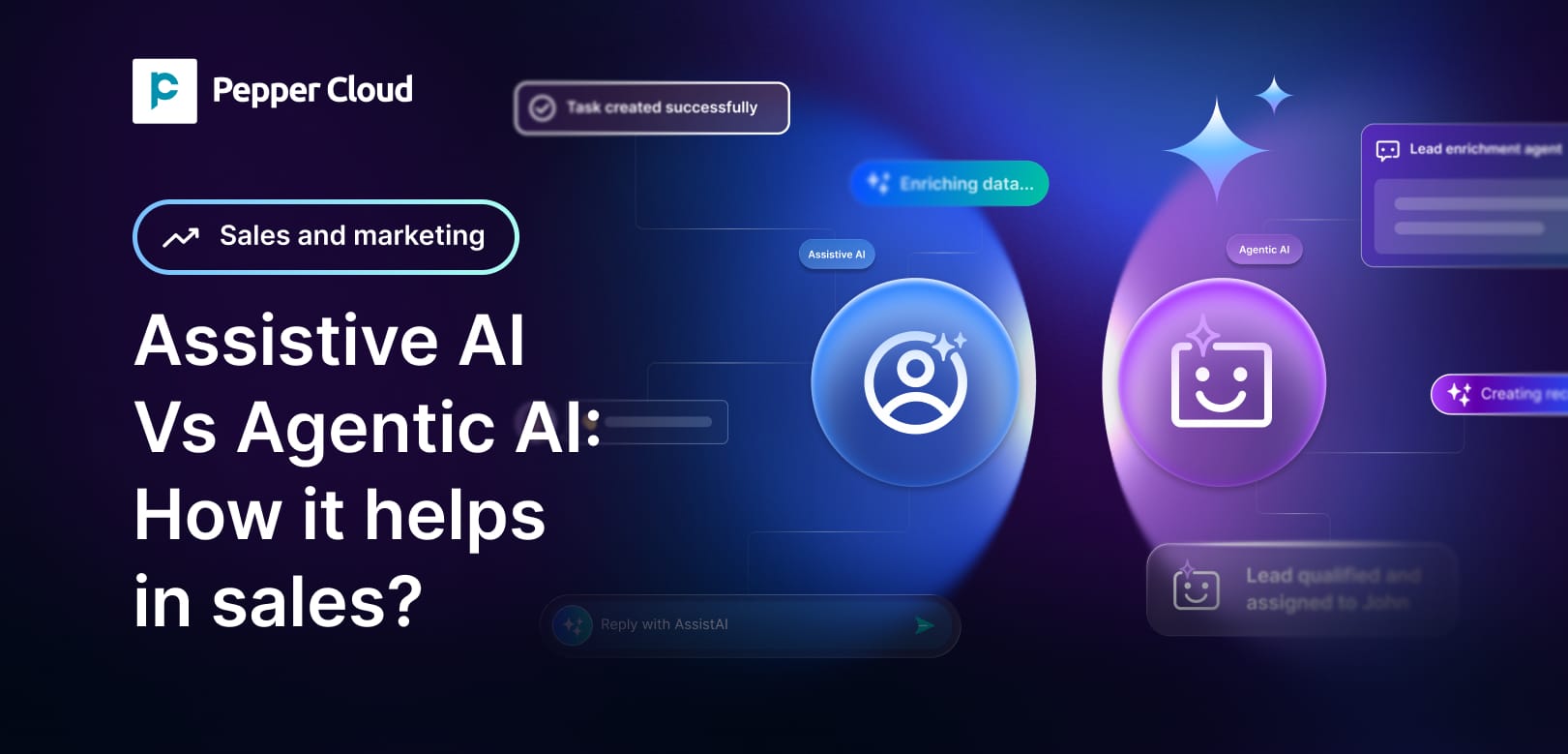
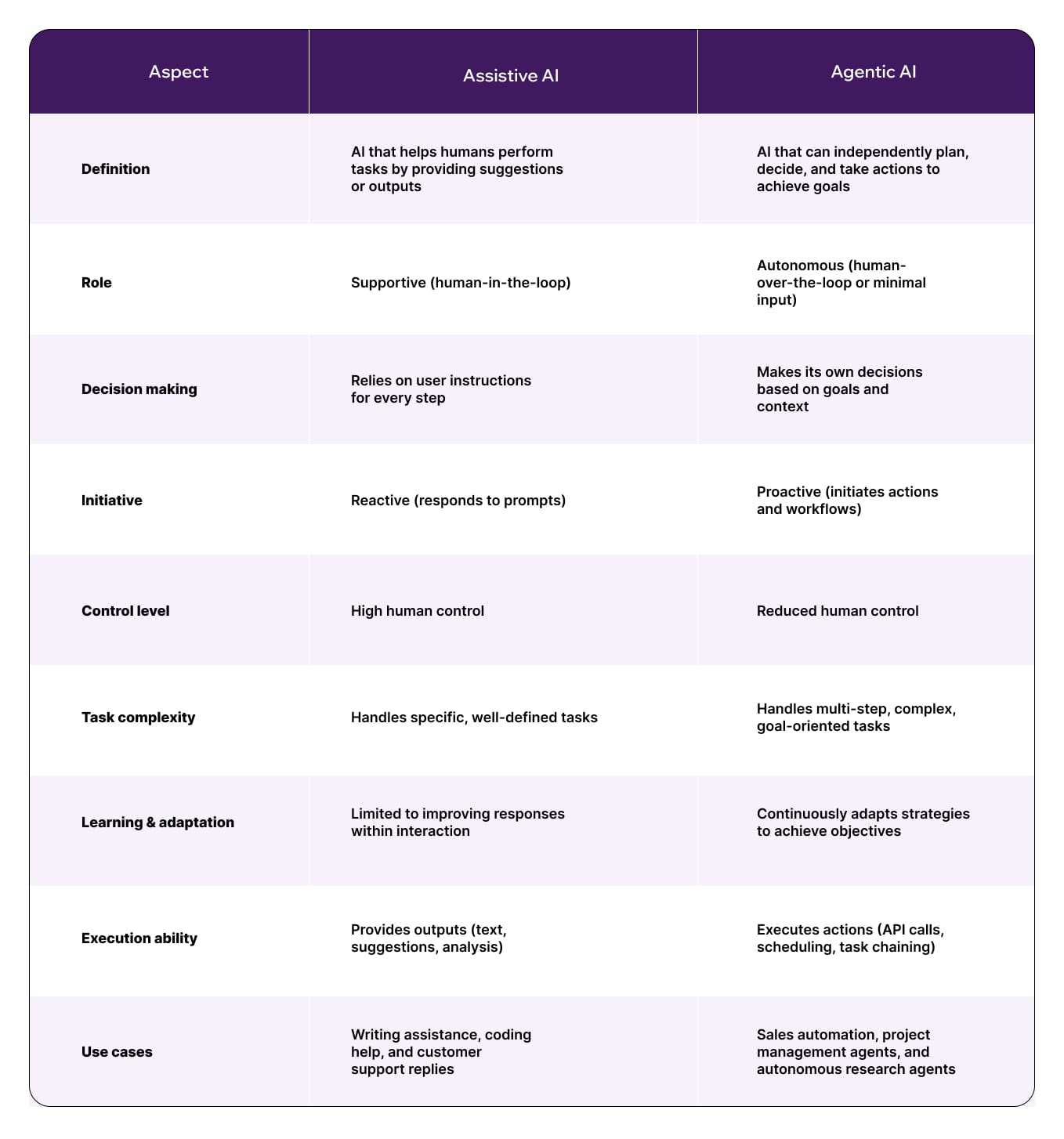
Assistive AI is what most teams are already familiar with. It looks at your data and tells you what to do next. Lead scores, follow-up reminders, risk flags, and meeting summaries. Genuinely useful, but someone still has to pick up the recommendation and act on it. The cognitive load stays with the rep.
Agentic AI removes that middle step. Instead of surfacing a suggestion and waiting, it takes the action itself, within defined rules and boundaries. It watches for signals, makes a call, and moves the sales and support workflows forward without needing a human to kick things off each time.
Simple version: assistive AI helps your reps work smarter. Agentic AI works on their behalf.
How does agentic AI look in real life?
Here is a scenario that will feel familiar to most sales teams.
A prospect visits your pricing page three times in five days. They opened your last email. They attended a demo a couple of weeks ago. In a traditional CRM, those signals are scattered across different views and probably noticed too late, if at all.
With agentic AI, the lead management system connects those dots on its own. It recognises the buying intent, enriches the lead record, checks the interaction history, drafts a relevant follow-up, assigns it to the right rep, and updates the deal stage, all before anyone has even logged in that morning.
The rep gets a notification when it is time for an actual conversation. Everything leading up to that has already been handled.
Why is agentic AI trending now?
Honestly, a few things had to come together first.
The AI models themselves got a lot better. Not just at generating text, but at understanding context, following structured logic, and completing multi-step tasks reliably. That was not really possible two or three years ago.
CRM platforms also became more open. Better APIs and integrations mean systems can act across tools rather than just sitting in their own lane. And frankly, the business pressure has intensified too. Sales targets are up, teams are leaner, and anything that cuts admin time is getting serious attention.
Put those together, and you get a genuine tipping point.
 Pepper Cloud Marketing
How can agentic AI be used in sales and support?
Lead qualification and routing: Rather than scoring a lead and leaving it in a queue, the system enriches the record, checks it against your ideal customer profile, and routes it to the right rep automatically. The first outreach can even be triggered based on urgency or source. Nothing sits waiting for someone to notice it.
Follow-up automation: This is probably where the most deals are lost. Not because reps do not care, but because there is too much to track. Agentic AI monitors inactivity, picks up on return visits or engagement signals, and sends the follow-up before the moment passes. That kind of responsiveness is nearly impossible to maintain manually across a full pipeline.
Deal progression: Deals stall. It happens constantly. Agentic AI can spot where things are slowing down and do something about it, whether that is flagging the deal to a manager, scheduling a nudge, or drafting a proposal based on the latest conversation. The CRM stops being a record-keeper and starts actually helping move things forward.
Personalised outreach at scale: Personalisation sounds great until you are staring down 200 leads and a weekly target. Agentic AI pulls together CRM history, behaviour data, and campaign context to make outreach feel relevant without the rep having to write each one from scratch. For smaller teams, especially, this is a genuine game-changer.
Pipeline visibility for managers: Instead of waiting for Friday's pipeline review to find out where things stand, managers get a running picture. Which deals are at risk, where attention is needed, and what should be prioritised this week. It turns a reactive process into a proactive one.
 Pepper Cloud Marketing
Key agentic AI challenges you shouldn’t ignore
Data quality first, always: This part may seem less exciting, but it is foundational. If your CRM is full of duplicates, outdated contacts, and incomplete records, automation just makes those problems faster and more visible. Clean the data before you turn on the agents.
Keep humans in the loop: Automation is not a reason to stop paying attention. You need clear rules about what the system can do without approval, what needs a sign-off, and when a human should take over. Especially for high-value deals or sensitive conversations.
Adoption does not happen automatically: Some reps will be immediately on board. Others will feel like they are losing control of their pipeline. The framing matters: this takes the admin off their plate, it does not replace their judgment. Training and transparency make a real difference here.
Compliance still applies: AI-triggered messages are still your responsibility. GDPR, CAN-SPAM, and consent requirements do not disappear because a workflow sent the email instead of a person.
 Pepper Cloud Marketing
How to start without overcomplicating it
You do not need to automate everything at once. That usually creates more confusion than it solves.
- Audit your CRM data and fix the most critical gaps first.
- Identify which repetitive tasks are eating the most rep time.
- Pick one workflow automation to pilot; lead routing or follow-up sequences are good starting points.
- Define clear boundaries: what the system can trigger alone, what needs approval, and what always goes to a human.
- Track what matters: response times, conversion rates, and how reps are actually using it.
- Expand gradually based on what is genuinely working, not what looks impressive on paper.
Final thoughts
The shift from assistive to agentic AI is not really a technology story. It is a story about where sales teams spend their time and how quickly they can act on an opportunity.
The businesses that benefit most will not necessarily be the ones with the biggest budgets or the most sophisticated setups. They will be the ones who start with clean data, pick the right workflows to automate first, and bring their teams along rather than just switching things on and hoping for the best.
Agentic AI works best when it handles the process, and the humans handle the relationships. That balance is what makes it actually useful.
Frequently asked questions
What is the difference between assistive AI and agentic AI in a CRM? Assistive AI gives your team recommendations and lets humans decide what to do next. Agentic AI takes that step further by actually carrying out defined actions on its own, like sending a follow-up or updating a deal stage, without waiting for manual input.
Do I need a large sales team to benefit from agentic AI?
Not at all. Smaller teams often see the biggest impact because agentic AI fills the gaps that come with limited headcount. If you cannot afford to hire three more reps, automating your follow-ups and lead routing can make a real difference.
Is my CRM data good enough to start using agentic AI?
That depends on the state of your records. If you have a lot of duplicates, missing fields, or outdated contacts, it is worth cleaning those up first. Agentic AI acts on whatever data it finds, so poor data leads to poor actions.
Will agentic AI replace my sales reps?
No. It handles the repetitive process work so reps can focus on actual selling. Relationship building, negotiation, and complex deal management still need a human. Think of it as removing the admin, not the person.
Which CRM should I use if I want agentic AI features today?
Several platforms already offer this, including Pepper Cloud AI WhatsApp CRM. The right choice depends on your team size, budget, and which workflows matter most to you. Starting with a platform that has built-in automation rather than bolted-on tools usually works out better long term.
Key takeaways
- Assistive AI gives recommendations. Agentic AI takes action within defined workflows.
- The biggest wins are in lead qualification, follow-up, deal progression, and pipeline visibility.
- Clean CRM data is the foundation. Without it, automation makes problems worse, not better.
- Start with one focused pilot and expand based on real results.
- Human oversight is not optional, especially in high-value or customer-facing situations.


