


How SMEs can use AI agent in an AI CRM to automate lead qualification
Discover how agent AI helps SMEs automate lead qualification in an AI CRM, improve speed-to-lead, and focus sales teams on real opportunities.
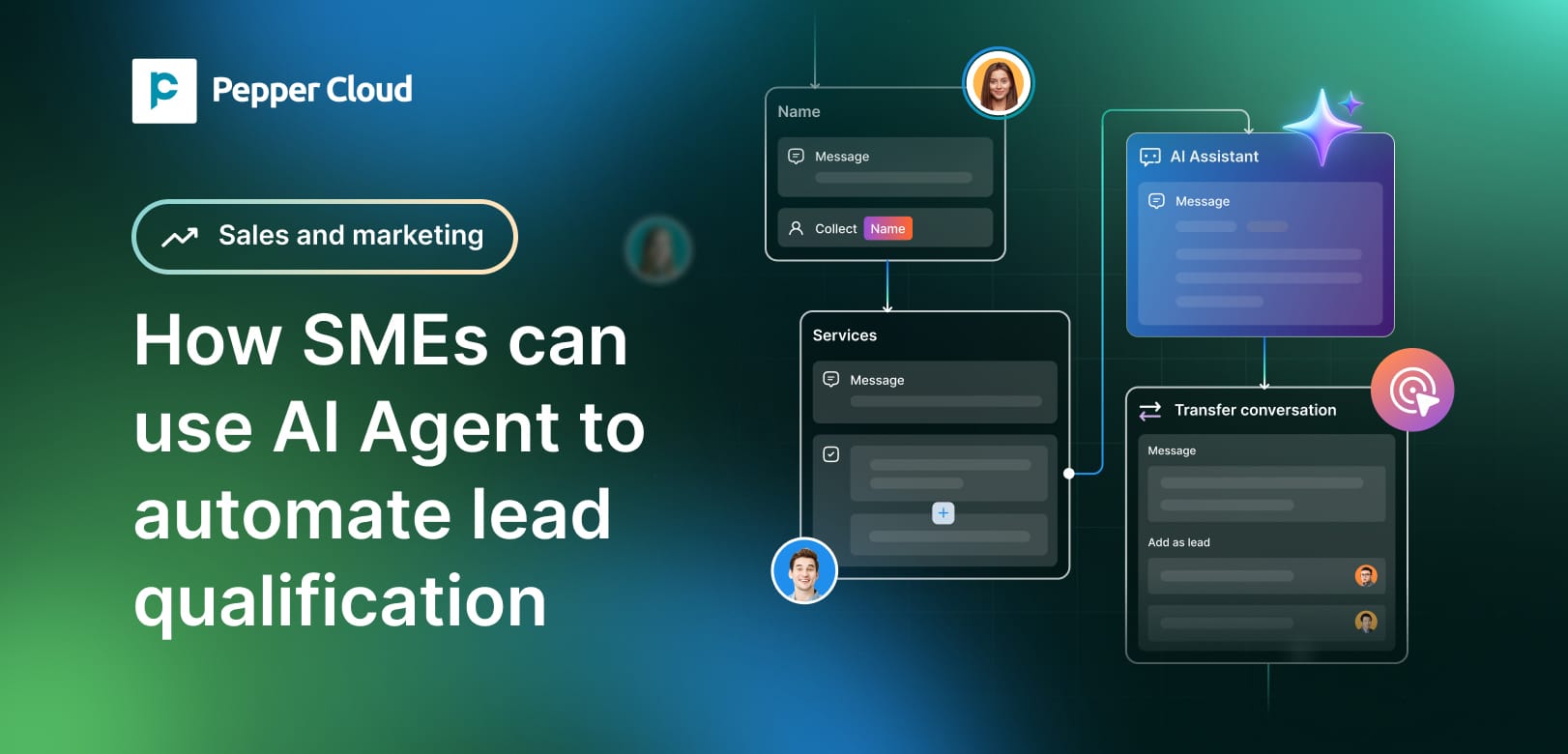

If you are running an SME sales team, lead qualification can feel like a daily trade-off: respond quickly, and you risk wasting time on poor-fit enquiries, or qualify carefully, and you lose deals because you replied too slowly.
The frustrating part is that speed really does matter. Research from InsideSales found that calling within 5 minutes vs 30 minutes dramatically improves outcomes. In other words, the odds of contacting a lead drop by 100X, and the odds of qualifying drop by 21X when you wait.
On top of that, InsideSales’ later analysis of inbound lead behaviour found that only a tiny fraction of leads are engaged within five minutes, while many first call attempts happen far later than they should.
That is exactly where agent AI inside an AI CRM can help: not just suggesting what to do, but doing the early work for you by asking the right questions, enriching the records, scoring fit and intent, routing the lead to the right person, and more.
But before we understand how Agentic AI can be your aid to qualify leads, first let’s understand what is a lead qualification AI agent.
What is an AI agent?
An AI agent is an autonomous system that can understand context, make decisions, and take actions on your behalf within defined boundaries. Unlike traditional automation, which follows fixed rules, an AI agent can actually execute tasks end-to-end.
What is a lead qualification?
A lead qualification AI agent is a specialised AI agent designed to assess, prioritise, and prepare inbound leads before they reach your sales team. It uses automated lead qualification using artificial intelligence to evaluate both fit (how well the lead matches your ideal customer profile) and intent (how ready they are to buy).
Instead of forcing prospects through long forms or relying on delayed manual follow-ups, the agent can ask relevant questions, enrich lead data, apply scoring logic, and route leads directly inside your AI CRM. This allows you to automate lead qualification with AI while maintaining a consistent, human-like experience for every prospect.
For SMEs, this means you get back to the right leads faster and your sales team spends less time chasing enquiries that were never a good fit in the first place.
 Pepper Cloud Marketing
Why SMEs get stuck in the qualification bottleneck
Now that you know what a lead qualification AI agent is and how it works inside an AI CRM, the next question is why so many SMEs struggle with lead qualification in the first place.
In most SMEs, you’re working with limited cover and get stuck in the lead qualification bottleneck because:
- There is no dedicated SDR team for inbound leads
- Leads arrive through too many channels
- CRMs aren’t always maintained and kept perfectly clean
- There is no round-the-clock coverage for web forms, chat, and demos
So leads pile up, your best reps cherry-pick the “easy” ones, and the rest go cold. The cost is lost revenue, along with the lost confidence in your pipeline because no one trusts the quality leads within the CRM.
What “AI Agent” means inside an AI CRM
Once you move beyond definitions, the real value of agent AI shows up in how it changes the role of your CRM day to day.
Traditionally, a CRM has been a system of record. It stores lead details, logs activities, and reports on what’s already happened. Even when AI features are added, they’re often limited to insights or recommendations — flags that tell you what you should do next, but still rely on someone to actually do it.
Agent AI shifts that dynamic inside an AI CRM. Instead of waiting for manual input, the CRM becomes an active system that moves leads forward on its own. It connects data, logic, and workflows so that early-stage sales activity happens automatically and consistently, without relying on someone to be watching the inbox at the right moment.
For you, that means your sales team engages when there is genuine context and intent. The CRM stops being a passive database and starts acting more like an operational layer that protects speed, consistency, and focus.
 Pepper Cloud Marketing
How automated AI lead qualification looks in real
Here’s a realistic “agent AI” flow for automated lead qualification using AI:
- Lead comes in (web form, chat, email, LinkedIn, webinar).
- Agent checks CRM: “Is this a duplicate? Is there an owner already?”
- Agent enriches: company size, sector, location, tech stack (where available).
- Agent scores fit (ICP match) and intent (behaviour and urgency).
- Agent asks 2–4 clarification questions (via chat or email) if needed.
- Agent routes the lead and creates tasks, notes, and next steps in your CRM.
- Agent alerts the right rep, with a short “why this is qualified” summary.
The outcome: your reps spend time on conversations, not admin.
Set your qualification rules before you automate anything
Once your CRM starts taking action instead of just storing data, one thing becomes obvious very quickly: the agent can only be as effective as the rules it’s working with.
Agent AI works best when you are clear on what “qualified” means for your business.
Before you automate, define:
- Your ICP fit rules: industry, geography, employee range, budget bands, use case.
- Your disqualifiers: students, competitors, unsupported regions, tiny budgets, etc.
- Your qualification questions: keep them short and friction-free.
A simple approach that works well in SMEs is splitting the qualification into:
- Fit (are they right for you?)
- Intent (are they ready now?)
Tip: If you can’t explain your rules on one page, your agent won’t magically fix the complexity, instead it will just automate confusion.
Build your agent AI workflow in six steps
1) Capture every inbound lead in one place
Pipe all sources into your AI CRM: forms, chat, inbox, ads, events. If you let channels live in silos, you’ll never get consistent automated lead qualification.
2) Standardise the CRM fields your agent can trust
At minimum:
- lead source
- product interest
- country/region
- company size band
- persona/role
- notes + last touch
3) Add lightweight enrichment
Even basic enrichment (industry + employee range + website) helps your agent make better routing decisions.
4) Create an AI scoring model you can explain
Start simple. Example signals:
5) Let the agent ask the missing questions
Instead of forcing a 12-field form, let the agent follow up with 2–3 questions like:
- “What are you using today?”
- “How many users/locations do you need to support?”
- “When do you want this live?”
6) Decide the handover point
Your agent should hand over when:
- Score threshold is met and
- Key fields are present and
- Next action is clear (book meeting/call within SLA)
How to automate lead qualification and routing in CRM
Qualification without routing is only half the win. You also want to automate lead qualification and routing in CRM, so the right rep gets the right lead fast.
Routing logic usually blends:
- Territory (UK, EMEA, etc.)
- Product line (Module A vs Module B)
- Account ownership (existing customer vs net-new)
- Capacity (round-robin with guardrails)
With Pepper Cloud, you can automatically route the leads with the help of round-robin logic.
Lead qualification AI agent implementation checklist
If you are wondering where to start, here is a quick checklist to leverage lead qualification AI agent for your business.
⏹️ Review 20 leads weekly and refine
⏹️ Add handover rules and SLA alerts
⏹️ Build routing rules (territory + product + capacity)
⏹️ Write 3 follow-up questions your Lead qualification AI agent can ask
⏹️ Create a simple fit/intent scoring model
⏹️ Pick 6–10 CRM fields your agent will use
⏹️ Define ICP + disqualifiers in plain English
Lead qualification AI agent - Frequently asked questions
1. Is automated lead qualification using AI suitable for small teams?
Yes, SMEs often benefit most because you can’t afford slow follow-up or manual triage, and agent AI can cover gaps outside working hours.
2. What is the difference between AI agent and agentic AI?
AI agent is an individual entity built for a specific task independently. They work on a set of rules, and their intelligence is limited to the tasks they are built for. On the other hand, the agentic AI is an advanced framework that represents a complete system. It can collaborate, communicate, and coordinate with multiple AI agents to resolve multi-step, complex problems.
3. How long does it take to set up automated lead qualification in an AI CRM?
A basic setup can often be live in weeks, not months. You don’t need every rule or edge case defined upfront. Most SMEs start with simple fit and intent criteria, then refine as they see real leads moving through the system.
4. Where should SMEs start if they want to automate lead qualification with AI?
Start with inbound leads only. Focus on one or two sources, define what “qualified” means in simple terms, and automate first response and routing. Once that’s working smoothly, you can expand into scoring, enrichment, and multi-step workflows.
5. Can you automate lead qualification and routing in CRM without damaging lead experience?
You can, if you keep messages short, ask only a few questions, and hand over quickly when intent is high. Routing automation is widely used to speed up and match leads to the right rep.
6. Will a lead qualification AI agent replace SDRs or sales reps?
No. A lead qualification AI agent handles the early, repetitive work that usually slows teams down. It doesn’t replace human conversations — it makes sure those conversations happen at the right time, with the right context. Most teams use it to free up salespeople, not replace them.
Final thought
At this point, the question isn’t whether agent AI can help with lead qualification, it’s whether you are comfortable letting good leads sit unanswered while your team stays busy elsewhere.
You don’t need a full rollout or a complete setup to move forward. Start by looking at your inbound leads, your response times, and where decisions get delayed. That is where agent AI inside an AI CRM can make an immediate difference.
If you are serious about improving speed-to-lead and lead quality without adding headcount, the next step is simple: pick one inbound flow, define what “qualified” actually means for your business, and put it to work. The results tend to speak for themselves.


