


Effective sales strategies and automation using AI
This guide explores how AI sales automation is revolutionising the B2B landscape, offering actionable strategies for integrating AI into your CRM and messaging workflows to drive sustainable business growth.

The world of B2B sales has experienced a seismic shift. No longer do we think of "automation" as sending scheduled emails or performing basic data entry. Welcome to the world of AI sales automation. Machine learning and generative AI do not merely assist salespeople; they make decisions, predict outcomes, and personalise.
This is especially the case for small and medium-sized enterprises, where the stakes have never been higher. According to sales report, on average, 50% of a sales rep’s time is spent on administrative tasks, significantly reducing time available for revenue-generating activities.
To compete with larger enterprises, sales teams have to move faster and work smarter. With AI-driven sales strategies, businesses can now bridge the productivity gap and ensure all leads are nurtured.
Why AI sales automation is no longer optional
In a digital economy, manual sales processes are the silent killers of growth. Research consistently shows that sales representatives spend less than 35% of their time actually selling.
The rest is consumed by administrative tasks, lead research, and manual follow-ups.
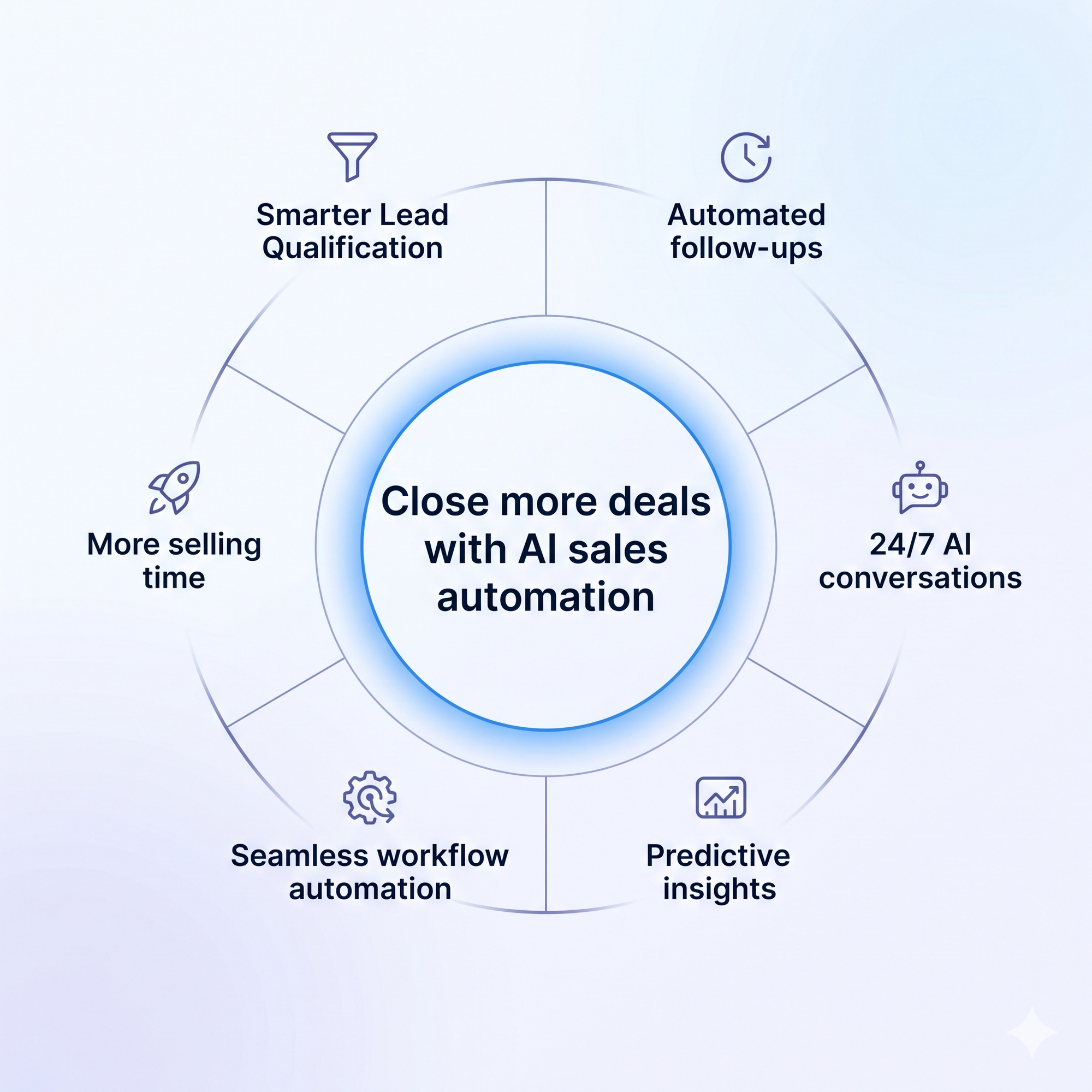
AI sales automation flips this script. It acts as a force multiplier, allowing a small team to handle the volume of a much larger department. From sentiment analysis in emails to predictive lead scoring, AI ensures your team focuses its human energy where it matters most: Closing deals and building relationships.
For many organisations, the first step is understanding the benefits of AI workflow automation to eliminate these repetitive bottlenecks.
 Pepper Cloud Marketing
1. Reimagining lead qualification and nurturing
The top of the funnel is often where the most time is wasted. Traditionally, "lead qualification" involved manual outreach and guesswork. AI changes this by analysing historical data to identify patterns in successful conversions.
- Predictive Scoring: Instead of treating every lead the same, AI assigns a "propensity to buy" score based on data points and intent signals.
- Automated Nurturing: Using AI, you can move beyond rigid workflows. AI can adjust the tone and timing of follow-ups based on prospect interactions.
However, for SMEs who want to use these advanced features, working with experts in AI development services will enable them to customise models to their industry's needs. Moreover, using a lead qualification guide will ensure the appropriate framework is used for AI training, such as BANT or CHAMP.
2. Conversational sales: The power of AI chatbots
WhatsApp and social messaging have become the primary channels for B2B communication. However, managing 24/7 enquiries across multiple time zones is a logistical nightmare for most teams.
AI chatbots for sales act as the digital front line. They're not like those "old-school" bots that simply follow a script.
Instead, they utilise Natural Language Processing (NLP) to quickly respond to intricate product-related questions, schedule meetings on a salesperson's calendar, and escalate high-value conversations to a human sales agent with a summary of all that was discussed.
This allows your "Unified Inbox" to be more than simply a repository for messages, but a driver for revenue.
Pepper Cloud Marketing
3. Enhancing CRM with AI insights
A CRM should be more than a digital Rolodex; it should be an advisor. AI in customer relationship management allows managers to see "at-risk" deals before they fall through.
Using AI to analyse communication frequency and sentiment can identify when the prospect's interest is declining. This provides sales leaders with an opportunity to develop a strategy.
In addition, AI can help eliminate the tedious task of updating your CRM. Voice-to-text tools and email scrapers keep your CRM up to date. Automating your CRM workflow can save considerable time spent on updating your CRM.
If your current system lacks these capabilities, it might be time to hire an AI development company to build custom integrations that connect your WhatsApp CRM with advanced analytical engines.
4. Workflow automation: The "invisible" sales assistant
True efficiency comes from automating the "hand-offs" between departments.
When a lead moves from "Qualified" to "Proposal Sent," AI-driven workflow automation seamlessly triggers actions, generating contracts, notifying finance, and setting follow-up tasks.
This ensures no lead falls through the cracks and the "Customer Lifecycle" remains a smooth, professional journey. Many teams find that automating sales tasks, such as activity logging and pipeline updates, can save them up to a full workday each week.
Practical use cases for SME
To truly understand the "how," let’s look at how AI sales automation manifests in real-world scenarios:
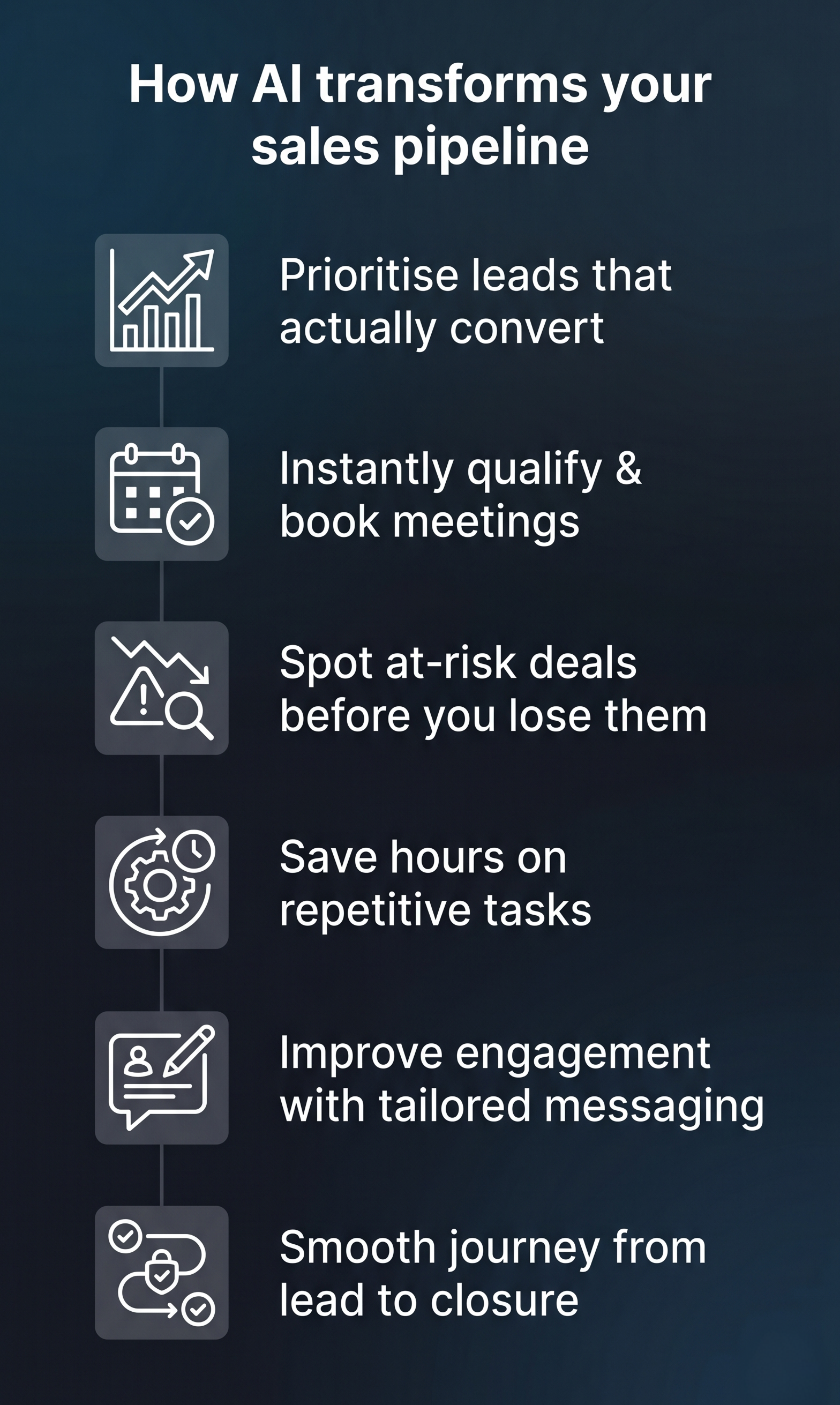
The WhatsApp Lead Surge: An SME running a social media campaign receives 500 WhatsApp enquiries in 24 hours. With AI sales automation, a bot filters the leads, identifies the 50 most "ready-to-buy," schedules calls for them, and sends brochures to the remaining 450.
The Stalled Pipeline: A Sales Manager looks at a pipeline of 100 active deals. The AI flags 5 deals where the prospect hasn't replied in 7 days, and the sentiment was "uncertain." The AI suggests a specific "re-engagement" case study to send to those individuals.
Pepper Cloud Marketing
Overcoming the "human" barrier
A common fear is that AI will make sales feel cold. In reality, the opposite is true. By removing robotic tasks from your human staff, you give them more time to be human. A rep who isn't bogged down by admin can spend more time building genuine rapport. AI doesn't replace the salesperson; it equips them with a "super-suit" of efficiency.
5 actionable key takeaways
- Audit your pipeline: Identify repetitive tasks. If a task follows a simple logic, it is a prime candidate for AI sales automation.
- Integrate your channels: Don't let WhatsApp conversations live in a vacuum. Use a WhatsApp CRM that allows AI to track these interactions alongside email data.
- Start with lead scoring: Implement AI-driven lead scoring to ensure your high-value reps speak only with prospects with genuine intent.
- Use conversational AI: Deploy AI chatbots for sales to handle initial enquiries with a seamless escalation path to a human agent.
- Focus on clean data: AI is only as good as the data it consumes. Ensure your team uses the CRM consistently so the AI can provide accurate forecasts.
Final thoughts
The move to AI sales automation is a journey, and the goal for SMEs is to build a scalable engine that grows with the business. You are not just keeping up with the competition by adopting AI sales strategies; you are leading the way into the future. What it takes to be a success in 2026 is a combination of the human touch and efficiency.
Frequently asked questions
1. What is AI sales automation?
AI sales automation uses machine learning and AI tools to automate tasks like lead qualification, follow-ups, and data entry while also predicting outcomes and personalising interactions.
2. Why is AI sales automation important for SMEs?
It helps small teams handle larger workloads, improve efficiency, and compete with bigger enterprises by reducing time spent on manual tasks.
3. How does AI improve lead qualification?
AI uses predictive scoring and behavioural data to identify high-intent prospects and prioritise leads more accurately than manual methods.
4. Can AI replace human salespeople?
No, AI supports sales teams by handling repetitive tasks, allowing them to focus on building relationships and closing deals.
5. What role do AI chatbots play in sales?
AI chatbots manage 24/7 enquiries, qualify leads, schedule meetings, and escalate important conversations to human agents.