


8 AI lead nurturing strategies to convert more leads
Discover AI lead nurturing strategies that personalise follow-ups, improve engagement, and help businesses convert more qualified leads faster.

Most teams already have more leads than they can manually keep up with. Tabs stay open. Reminders get ignored. Follow-ups get pushed to “later.” And “later” never really shows up on time. AI lead nurturing changes the energy of that process and makes the entire journey more responsive.
Intrigued? Good... because there is more where that came from. We will show you what AI lead nurturing is and also share 8 strategies to build an adaptive setup that responds to movement already happening inside the sales funnel.
What is AI lead nurturing?
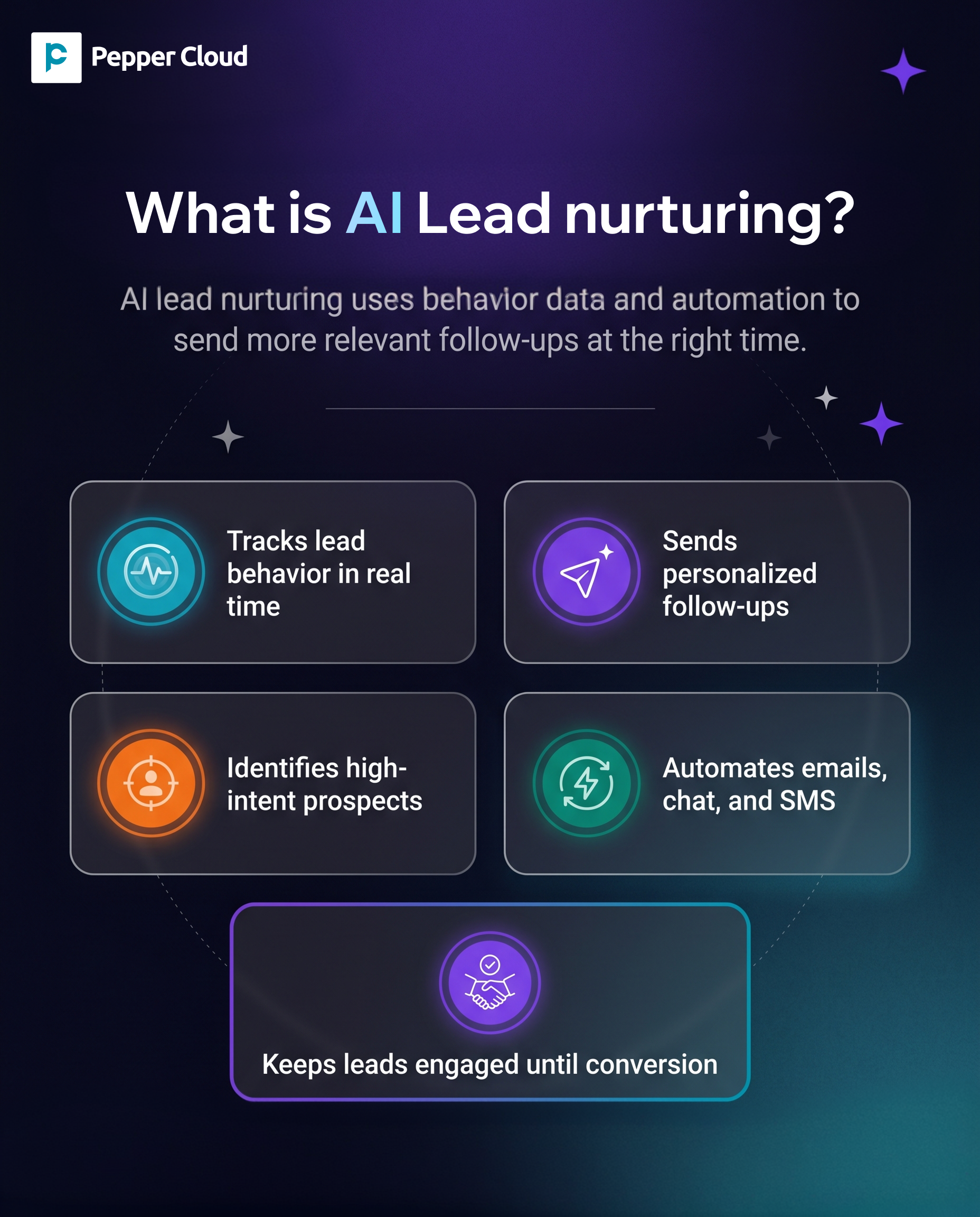
AI lead nurturing is the process of using artificial intelligence to guide potential customers through the buying journey in a more timely and personalised way.
Rather than sending the same follow-up emails or messages to everyone, AI studies how each lead behaves. It looks at things like:
- What pages they visit
- What emails they open
- What they click
- How often they engage
Based on that, it helps decide what message to send next, when to send it, and through which channel. The goal is to keep leads engaged until they are ready to take action, without overwhelming them or losing their attention along the way.
 Pepper Cloud Marketing
Why AI lead nurturing is important for your business: 5 key benefits
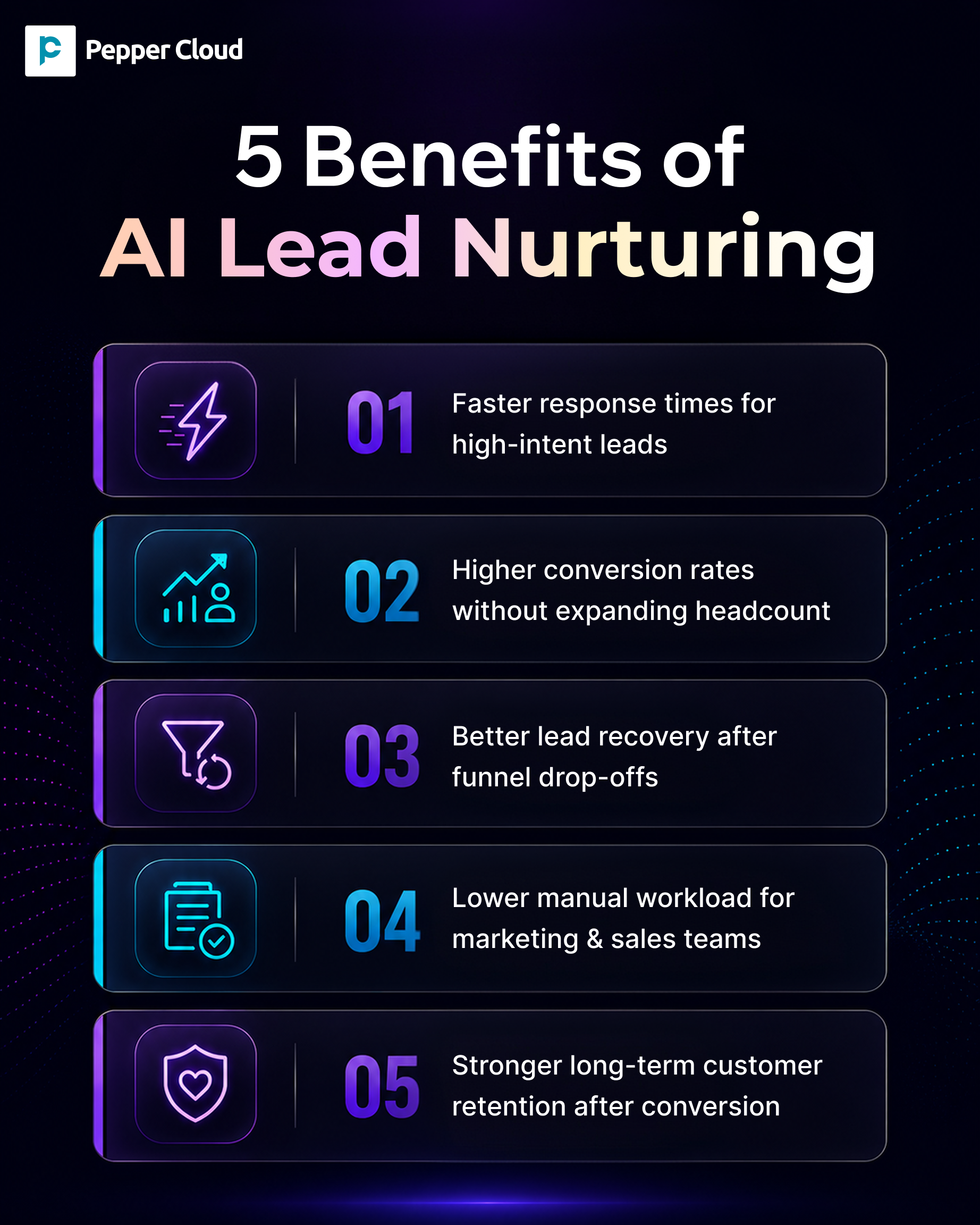
Here are 5 clear reasons that show why AI lead nurturing process deserves a central role in your growth strategy.
1. Faster response times for high-intent leads
A lot of businesses lose qualified leads before the sales process even begins – not because the product is bad, but because the response takes too long.
Someone visits your pricing page twice, fills out a demo form, and is clearly interested. Then… silence for six hours. By that point, they have already checked out three competitors and forgotten your brand name.
AI lead nurturing fixes this. Rather than a lead getting an auto-response that says, “Thanks, our team will contact you shortly,” they immediately get useful engagement. Maybe AI asks what they are looking for. Maybe it shares the exact feature they were browsing. Maybe it offers available meeting slots right away. That changes the entire feel of the interaction.
2. Higher conversion rates without expanding headcount
There is a point where growing lead volume stops being exciting. More inquiries come in. More follow-ups are needed. Most companies try to solve this by hiring more people. But that gets expensive very quickly.
AI lead nurturing campaigns help businesses grow conversions without constantly growing the team alongside it. Not because AI magically closes every deal, but because it handles all the small but important interactions that usually get skipped when sales and marketing teams are overloaded.
Someone who watched a product tutorial might receive setup-related information next. Someone exploring enterprise pages might get content focused on scalability or implementation. That is where conversion rates improve.
Another thing businesses underestimate is follow-up consistency. Human teams are inconsistent by nature. Some reps follow up perfectly. Others forget. Some leads get five touchpoints. Others get one and disappear forever. Implementing AI lead nurturing tools alone can noticeably improve close rates without increasing headcount at all.
 Pepper Cloud Marketing
3. Better lead recovery after funnel drop-offs
If someone abandons a signup form or stops replying after one conversation, the lead just stays there untouched forever. AI lead nurturing keeps working the opportunity without forcing it because it doesn’t assume silence means permanent disinterest.
For example, someone might start booking a demo but leave halfway through. Instead of losing that lead completely, AI can follow up with something actually useful – maybe a shorter walkthrough option or a customer example from the same industry. That is very different from sending the usual “Just checking in…” email that everybody ignores.
And honestly, recovering old leads is far cheaper than the new lead generation process from paid ads and marketing efforts every month. Businesses spend huge amounts attracting traffic, then let half their interested prospects disappear because nobody had time to continue the conversation properly.
4. Lower manual workload for marketing and sales teams
One of the least talked-about problems inside growing companies is how much energy is wasted on small repetitive tasks. Not difficult tasks. Just constant ones. And none of those is complicated individually. But together, it consumes entire workdays.
AI lead nurturing takes a huge amount of pressure off daily operations. If someone suddenly becomes more engaged, the system responds differently. If someone goes inactive, the communication changes again. Those adjustments happen continuously without constant human involvement.
And when teams have less admin work, conversations improve too. Reps can focus properly during calls instead of multitasking between systems or trying to remember where a lead left off last week.
5. Stronger long-term customer retention after conversion
What happens right after someone becomes a customer usually decides whether they stay for three months or three years. And this is where AI lead nurturing efforts become surprisingly useful beyond just generating sales.
Instead of every customer receiving the same generic onboarding sequence, communication can adapt based on actual usage behaviour. If someone hasn’t completed setup, AI can simplify the next step. If they are only using basic features, it can introduce more advanced capabilities gradually. That makes the experience more alive and responsive over time.
It also prevents one major retention problem businesses rarely notice early enough: silent dissatisfaction. A lot of unhappy customers never complain. AI can detect those behavioural changes much earlier than humans usually do
Pepper Cloud Marketing
8 AI lead nurturing strategies that will improve conversion rates across the customer journey
Here are 8 practical AI lead nurturing strategies you can apply across the entire buyer’s journey to get real conversions.
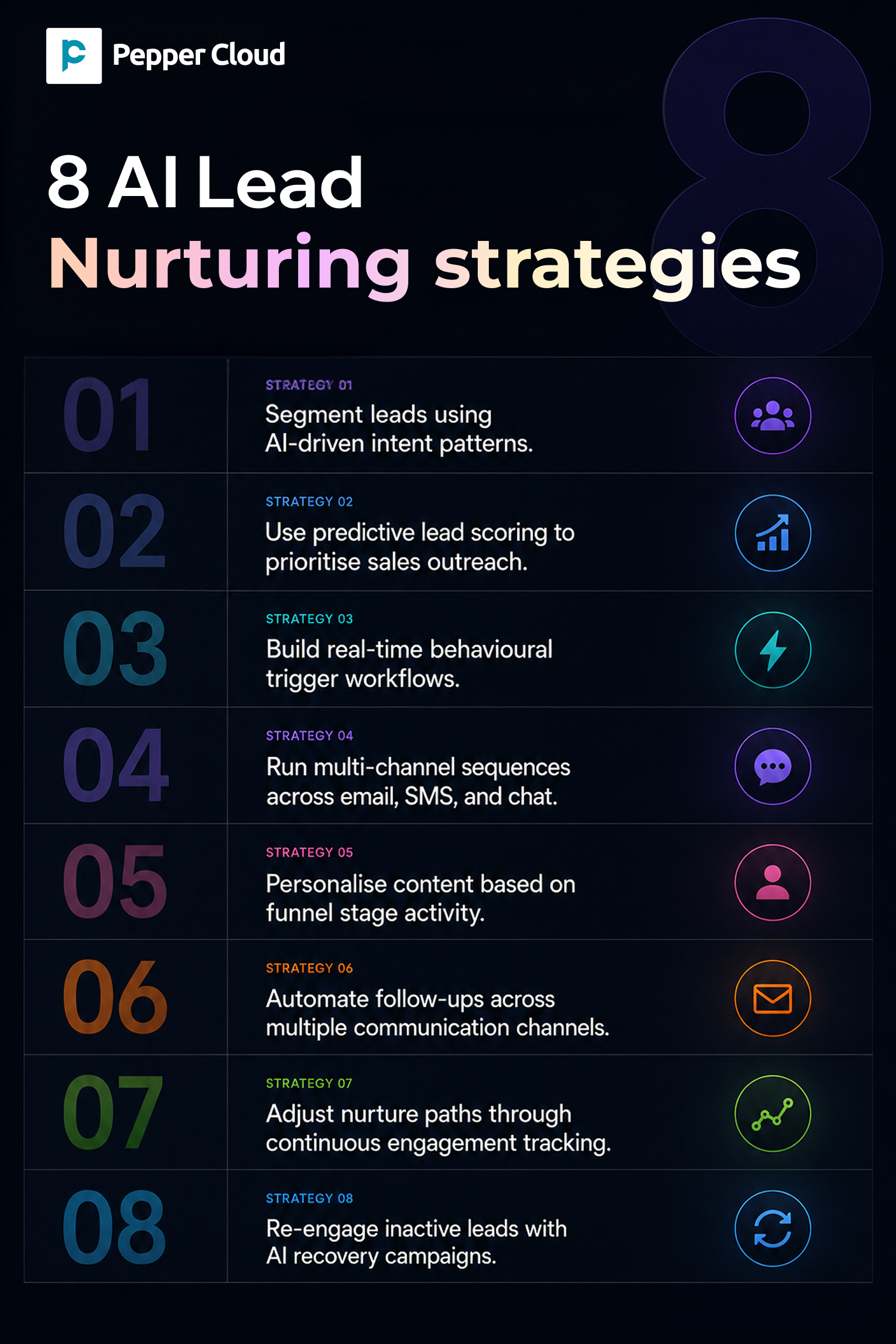
1. Segment leads using AI-driven intent patterns
Most businesses still segment leads in very basic ways. Industry. Job title. Company size. Location. Useful? Sure. But none of those things actually tells you what somebody is trying to do right now.
A founder reading your pricing page at 1:12 AM for the fourth time this week is in a completely different mindset than someone casually reading a beginner blog article during a coffee break – even if both work at companies with the same employee count.
That is the real value of AI-driven intent segmentation. It groups people based on behavioural momentum and relevant information rather than generic labels.
Do This:
- Build a segment specifically for leads repeatedly visiting pricing or comparison pages outside business hours. These buyers respond well to low-friction next steps.
- Create a separate nurture track for people who jump directly into technical documentation early.
- Train AI to identify “internal validators” – leads who repeatedly open shareable assets. Send content designed to help them sell your product internally to stakeholders.
- Detect “hesitation cycles” where leads repeatedly revisit one objection-heavy page. Trigger hyper-specific reassurance content tied to that exact concern.
2. Use predictive lead scoring to prioritise sales outreach
Sales teams waste a shocking amount of time figuring out who is serious. Not because they are bad at sales. Because modern buying behaviour is complicated. And humans are not naturally great at spotting these patterns consistently across hundreds or thousands of leads. AI is.
Predictive lead scoring works because it doesn’t rely on assumptions. Instead, AI studies what converted customers actually did before they purchased. And the patterns are surprisingly specific. So rather than sales reps chasing whoever shouted loudest first, they focus attention where buying probability is genuinely rising.
Do This:
- Give extra predictive weight to “compressed curiosity” behaviour – leads rapidly jumping across pricing, integrations, onboarding, and customer proof pages.
- Lower scores automatically for leads who consume only broad educational content over long periods without progressing toward product-specific behaviour.
- Build “urgency spikes” into scoring logic. If a previously inactive lead suddenly becomes highly active within 24 hours, prioritise them immediately.
- Include behavioural consistency when scoring leads. Leads returning repeatedly over several weeks convert better than one-time high-engagement visitors.
Pepper Cloud Marketing
3. Build real-time behavioural trigger workflows
A lot of automated lead nurturing is delayed in a strangely obvious way. You look at something… then two days later, an email arrives pretending it is connected to what you did. That lag kills momentum. Real-time behavioural workflows fix that by reacting while interest is still emotionally active.
And that is important because people don’t move through buying journeys in neat timelines anymore. Interest comes in bursts. AI-triggered workflows respond within those moments instead of after them. Not with random automation spam. With context-aware movement.
Do This:
- Trigger “decision support” workflows the moment leads revisit pricing pages multiple times. Include timelines, ROI breakdowns, and objection-handling content.
- Launch rescue workflows within minutes after incomplete demo bookings or abandoned onboarding sessions.
- Detect “research acceleration” behaviour where high-quality leads suddenly consume much more content than usual in one sitting.
- Build workflows around hesitation behaviour. Repeated hovering around one feature category shows unresolved concerns worth addressing proactively.
4. Run multi-channel sequences across email, SMS, and chat
People don’t communicate the same way in every situation. That is why single-channel nurturing fails so often.
Email might work perfectly for detailed explanations. But terrible for urgency. SMS might work great for reminders. But it is intrusive for long-form education. Live chat works beautifully when somebody is actively evaluating. But useless when they are away from your site entirely.
AI helps coordinate all of this without making communication chaotic. It notices the interaction preferences and adapts the sequence naturally. The experience becomes smoother because personalised communication starts matching how people actually behave.
Do This:
- Give each channel a clear behavioural purpose. Use:
- Email for explanation-heavy content
- SMS for momentum-preserving actions
- Live chat for removing hesitation during active browsing
- Configure AI to detect “channel fatigue.” If engagement drops sharply on one platform, reduce usage there automatically.
- Suppress overlapping outreach automatically when leads engage heavily on one channel.
- Analyse which channel produces the fastest responses for each lead individually, then gradually prioritise future communication there.
Pepper Cloud Marketing
5. Personalise content based on funnel stage activity
A lot of personalisation today is fake personalisation. Adding somebody’s first name to an email is not personalisation. Knowing what they are trying to solve right now is. Early-stage buyers are trying to understand the problem itself. Mid-stage buyers are comparing approaches. Late-stage buyers are trying to reduce risk.
AI helps prevent the mismatch here. It watches lead behaviour closely enough to estimate where buyers actually are psychologically… even when they never explicitly say it. That creates a much smoother decision-making experience overall.
Do This:
- Transition leads out of educational nurture immediately once they start consuming operational or pricing-related content heavily.
- Deliver “decision-support” content like ROI calculators or stakeholder presentation templates only after leads start revisiting pricing or enterprise-related pages.
- Introduce onboarding walkthroughs before purchase for highly engaged late-stage leads to reduce fear around switching effort and implementation complexity.
- Track whether leads consume relevant content quickly or slowly. Fast consumption means urgency, while slow but spaced-out engagement requires longer nurture pacing.
6. Automate follow-ups across multiple communication channels
Most businesses lose leads quietly. That is usually because sales pipelines are full of invisible follow-up issues. Too much follow-up looks desperate. Too little follow-up makes your company feel disorganised. AI helps maintain the middle ground consistently across large lead volumes.
And people trust businesses that are organised. When communication is timely and contextual, the buying experience becomes smoother automatically.
Do This:
- Create communication escalation logic. If emails go ignored but website activity stays high, shift toward live chat engagement.
- Automate post-call follow-ups within minutes while conversation memory is still fresh. Include exact resources and agreed next steps automatically.
- Build inactivity-specific follow-up timing. Highly engaged leads should receive tighter response windows than passive subscribers.
- Trigger follow-up variations based on friction type. Proposal inactivity requires different messaging than onboarding abandonment or unanswered demo invitations.
7. Adjust nurture paths through continuous engagement tracking
One of the strangest things about traditional lead automation is how stubborn it is. Someone can completely change behaviour…and the nurture system just keeps going as if nothing happened.
AI-driven engagement tracking fixes that rigidity. It constantly watches how momentum changes throughout the customer relationship. Not just click-through rates or opens. The pattern underneath them. And once nurture paths adjust dynamically, communication becomes much more aligned with reality.
Do This:
- Slow nurture frequency automatically when engagement depth weakens over time. Constant outreach during declining interest periods accelerates disengagement.
- Move leads into higher-touch sequences when they start consuming operationally detailed content.
- Detect “evaluation stalls” where engagement stays active, but progression stops. Trigger objection-resolution content.
- Build engagement-decay monitoring that identifies gradual disengagement patterns before leads disappear entirely.
Pepper Cloud Marketing
8. Re-engage inactive leads with AI-driven recovery campaigns
Most inactive leads are not dead. They are paused. And this distinction matters. Businesses usually misread that silence completely. Instead of understanding context, they either spam generic reactivation emails or give up entirely.
AI recovery campaigns work differently because they look backward before trying to reconnect. That historical prospect data decides the recovery strategy. Because somebody who disappeared after implementation research needs a very different re-entry point than somebody who vanished after comparing pricing.
Do This:
- Re-engage stalled implementation-focused leads with simplified rollout timelines and customer migration stories instead of generic “checking in” emails.
- Trigger recovery campaigns when dormant leads start anonymously revisiting decision-stage pages again.
- Build “unfinished evaluation” sequences referencing the exact product areas previously explored most heavily.
- Use AI to identify leads whose recent behaviour suddenly resembles historical pre-conversion patterns, even if they have been inactive for months.
3 AI lead nurturing examples from real-world businesses you can learn from
Let’s look at 3 examples that show how real teams use AI lead nurturing and what you can take from them.
1. Mannequin Mall
Mannequin Mall noticed that boutique owners were opening the same mannequin product pages over and over during late-night hours, especially between 10 p.m. and 1 a.m., but conversions stayed inconsistent.
After digging deeper, they realised most buyers were comparing visual display ideas after store closing hours, then forgetting the products by morning. So they changed how their AI lead nurturing worked.
Instead of sending generic abandoned-cart emails, the system started reacting to browsing combinations. If someone spent time comparing matte white male mannequins with athletic poses and then viewed rotating bases within the same session, the lead automatically entered a “window display planning” sequence.
The follow-up emails looked nothing like eCommerce campaigns. One email showed spacing layouts for three-mannequin storefront setups. Another recommended lighting angle that reduces glare on glossy finishes.
A third email arrived exactly 18 hours later with shipping estimates tied to the visitor’s region because the company noticed retail buyers became price-sensitive once freight costs entered the picture.
That timing shift changed how leads behaved. Buyers stopped treating the site like a research tab and started replying directly to emails with store dimensions and floor plans. The lesson here had nothing to do with personalisation tokens. Mannequin Mall built its nurturing flow around how retail buyers actually make merchandising decisions in real life.
2. IceCartel
IceCartel custom grillz store found that a huge percentage of first-time grillz shoppers kept sifting between “diamond grillz” collections and the FAQ pages about molds and sizing kits. Most of those visitors were not confused about style. They were nervous about getting the process wrong.
So their AI lead nurturing system started tagging visitors based on friction behaviour. If someone revisited the molding instructions more than twice without adding anything to the cart, they stopped receiving product-heavy emails entirely. Instead, the system moved them into a reassurance-focused sequence built around process confidence.
One email showed a customer remaking their mold after messing up the first attempt. Another broke down how long impressions stay usable before shipping them back. A third email arrived only after the lead revisited financing pages twice within one week.
The timing became extremely specific, too. IceCartel noticed that high-intent buyers revisited product pages after midnight from mobile devices, usually right after spending time on Instagram. Those visitors received short-form SMS reminders with sizing kit walkthroughs instead of long desktop-style emails.
That small adjustment changed response rates because the brand stopped selling grillz and started reducing uncertainty at the exact moment hesitation showed up.
3. Freeburg Law
Freeburg Law family attorney realised that their leads rarely move in a straight line. Traditional lead scoring saw those visits as random activity. Their AI system read them like emotional sequencing.
The firm built lead nurturing around “return behaviour intensity.” If someone came back to custody-related pages three separate times without filling out a form, the system stopped showing aggressive consultation prompts. Instead, it shifted into slower educational touchpoints.
One follow-up email explained how temporary custody schedules usually work during the first 30 days after separation in Wyoming. Visitors reading mediation-related pages received completely different sequences focused on communication structure and parenting coordination instead of courtroom language.
The firm also noticed that leads returning late at night behaved differently from daytime visitors. Midnight traffic spent longer on emotional-content pages and less time on attorney bios. So those visitors received calmer and process-oriented follow-ups instead of direct “schedule your consultation” messaging.
That detail mattered because divorce leads are usually not comparing law firms the same way someone compares software tools or sneakers. Freeburg Law built its AI lead nurturing around emotional pacing, and that changed how people entered conversations with the firm.
Conclusion
AI lead nurturing isn’t meant to flood people with touchpoints every few hours. The goal is to stay aware of movement while it is happening and respond before interest cools off. So make it the core of your process. Build around it. Refine it. Test it against real outcomes.
And more than anything, let AI handle pattern recognition and timing. Your team should handle judgment and relationship depth. That balance keeps the experience natural and focused.
At Pepper Cloud, we built our platform around exactly that idea. We bring your conversations, lead activity, follow-ups, pipelines, and automation features into one place so your team can respond faster without losing context.
We also built AssistAI to handle the repetitive work that slows the sales cycle down. It can analyse conversations, detect intent, automate follow-ups, summarise chats, trigger workflows, and help your team focus on building relationships and nurturing leads that are actually moving.
If you want AI lead nurturing to work as a practical growth system, we would love to show you how it fits into your workflow. Book a free demo and see our AI tools in action.