


How WhatsApp CRM helps growing B2B teams scale sales without hiring too fast
Discover how WhatsApp CRM helps growing B2B teams scale sales without hiring too fast. From automation to better visibility and follow-ups, learn how structured workflows improve response time, efficiency, and overall conversion performance.


As B2B companies grow, complexity increases long before revenue plateaus. One of the most overlooked bottlenecks appears in business messaging.
WhatsApp starts as a convenient channel for quick prospect communication. Sales teams use it to respond to enquiries, send pricing, confirm meetings, and handle follow-ups. It feels fast and personal.
- At a small scale, it works.
- At the growth stage, it breaks.
Messages sit on individual devices. Follow-ups depend on memory. Managers lack visibility into deal progress. Customer conversations overlap with sales discussions. Response time becomes inconsistent.
The issue is not WhatsApp itself. The issue is the absence of structure.
A well-implemented WhatsApp CRM allows B2B teams to scale communication efficiently. When paired with clear delegation and workflow ownership, it becomes a powerful operational system rather than just a messaging tool.
The hidden cost of informal WhatsApp sales
In many growing organisations, WhatsApp functions as an unofficial CRM. Sales representatives manage:
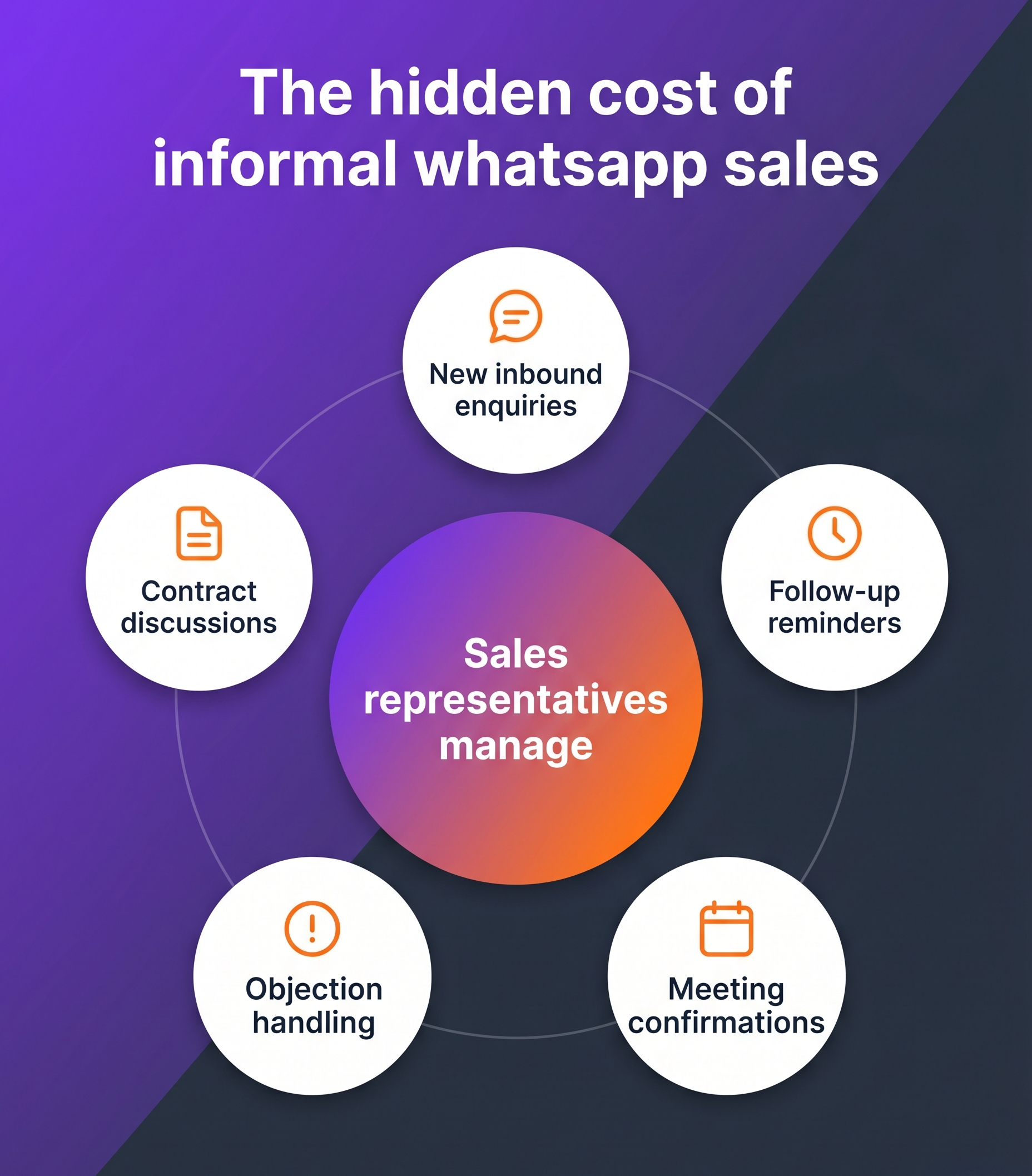
All inside chat threads. This creates several risks:
- Conversations disappear when a team member is unavailable
- No shared visibility into deal stage
- Inconsistent follow-up timing
- No measurable response time benchmarks
When revenue growth slows, leadership often assumes more sales hires are required.
In reality, the bottleneck is often workflow design. Before hiring, companies must evaluate whether their communication system can scale.
 Pepper Cloud Marketing
What a WhatsApp CRM actually changes
A WhatsApp CRM integrates business messaging directly into your customer relationship management system.
Instead of isolated chats, conversations become structured sales records. This allows teams to:
- Automatically log inbound messages
- Assign chats to specific representatives
- Tag leads by source or priority
- Track deal stage alongside conversation history
- Set automated follow-up reminders
- Measure response time and conversion performance
Visibility transforms performance. When conversations are centralised, sales leaders can monitor pipeline activity in real time. No opportunity is dependent on one individual’s phone or memory.
Pepper Cloud Marketing
Scaling through delegation, Not just technology
Technology alone does not solve growth problems. Process ownership does. Many B2B teams implement CRM systems but fail to define responsibility for monitoring them.
Consider these operational questions:
- Who monitors new inbound WhatsApp enquiries throughout the day?
- Who ensures follow-ups happen within 24 hours?
- Who reviews stalled conversations weekly?
- Who audits CRM data accuracy?
In high-performing teams, this responsibility is clearly delegated. For example, structured operational support roles can manage:
- Lead assignment oversight
- Follow-up compliance tracking
- CRM data hygiene
- Automation setup and refinement
Sales representatives focus on revenue conversations. Support roles ensure no opportunity slips through gaps.
This separation increases efficiency without expanding sales headcount.
Practical use case: Improving response time
Imagine a mid-sized B2B consultancy receiving 50 WhatsApp enquiries per week from website traffic and paid campaigns.
Before CRM integration:
- Enquiries arrive on one or two devices
- Response time varies between 30 minutes and several hours
- Follow-ups are inconsistent
- Managers have no visibility into lead status
After implementing AI WhatsApp CRM with structured workflow management:
- Incoming messages automatically sync into CRM.
- An instant acknowledgement message is triggered.
- Leads are assigned based on territory or availability.
- A follow-up reminder is automatically created if there is no response within 24 hours.
- Weekly reports track response time and conversion rates.
The result is measurable improvement:
- Average response time drops significantly
- Follow-up compliance improves
- Sales representatives regain time
- Fewer leads go cold
The improvement comes from system design, not additional hires.
Pepper Cloud Marketing
Using WhatsApp automation to protect revenue
Most B2B deals require multiple touchpoints. Without structured automation, follow-ups rely on manual reminders. In busy sales environments, this is where deals quietly disappear.
WhatsApp automation enables:
- Automated demo reminders
- Post-meeting recap messages
- Follow-up nudges after pricing discussions
- Re-engagement sequences for dormant leads
For example, after a product demo, an automated sequence can send a thank-you message, share a relevant case study and prompt scheduling of the next call.
Automation ensures consistency. Delegated oversight ensures accountability. Together, they protect revenue from simple operational gaps.
Strengthening customer support with centralised messaging
WhatsApp CRM benefits extend beyond sales. In B2B environments, customer support often shares the same messaging channel.
Without structure, this creates confusion:
- Escalations lack documentation
- Customer history is fragmented
- Multiple team members respond inconsistently
When integrated into CRM:
- Support conversations are logged and tagged
- Escalations are tracked
- Customer profiles display complete interaction history
- Performance metrics become measurable
This improves both experience and internal coordination. Sales and support can operate collaboratively instead of reactively.
The role of AI in WhatsApp CRM workflows
AI is increasingly embedded in CRM platforms. Within WhatsApp CRM systems, AI can assist with:
- Lead categorisation
- Intent detection
- Priority scoring
- Suggested response templates
For instance, high-intent phrases such as “pricing”, “demo”, or “proposal” can trigger priority routing to senior sales staff.
AI enhances efficiency, but it does not replace structured ownership. Technology identifies urgency. Humans execute decisions. This combination increases speed without sacrificing judgement.
Why systems should precede hiring
When demand increases, the instinctive reaction is to hire more salespeople. However, adding headcount without fixing workflow inefficiencies amplifies chaos.
Before expanding teams, B2B leaders should evaluate:
- Is response time measured and optimised?
- Are follow-ups automated and tracked?
- Is conversation ownership clearly defined?
- Is CRM data consistently updated?
If the answer is no, hiring more people compounds inefficiency.
Structured WhatsApp CRM implementation allows teams to handle greater volume without immediate expansion. This creates a more capital-efficient growth path.
Final thoughts
In B2B sales, growth rarely stalls because of lack of effort. It stalls because of operational friction.
WhatsApp CRM introduces visibility. Automation introduces consistency. Delegation introduces accountability.
Together, they create a scalable communication system that supports sustained revenue growth.
For growing B2B teams, structured messaging is no longer optional. It is foundational to efficient scaling. Ready to eliminate friction and scale smarter?
Start using Pepper Cloud AI WhatsApp CRM to streamline conversations, automate follow-ups, and turn every interaction into measurable revenue. Book a demo today and see how your sales process transforms.
Key takeaways
- WhatsApp CRM transforms informal messaging into structured, trackable sales workflows.
- Automation reduces reliance on memory and improves follow-up consistency.
- Delegated operational oversight strengthens accountability and performance.
- AI enhances prioritisation but must operate within clear workflow ownership.
- Businesses should optimise communication systems before expanding headcount.