


How agentic CRM is changing sales in 2026: What it is and how it works
Agentic AI in CRM closes the execution gap that standard automation has never solved: where tasks get created, but nobody completes them. This guide breaks down what agentic CRM is, how its five core components work, and how sales can improve with agentic CRM.

Almost half of sales reps never follow up after making initial contact with a prospect. That one statistic sits at the centre of a problem that CRM systems have been promising to fix for over a decade, and still have not
The issue is not a lack of data or visibility. Modern CRM platforms give sales teams a detailed view of their pipeline. Every email open is tracked, every meeting is logged, and every deal stage is recorded. What CRM automation has not been able to do is act on that data when the person responsible for acting does not.
A workflow can create a task. A sequence can queue an email. But if the rep is in back-to-back calls, dealing with a higher-priority account, or simply overwhelmed, the task sits untouched, and the deal goes cold.
This is where an experienced custom CRM development company does its magic by building agentic CRMs that suit your industry and your organisation's sales requirements.
What Is Agentic CRM?
Agentic CRM is a CRM system that uses autonomous AI agents to execute sales and marketing tasks without waiting for human input. Instead of creating a task for a sales rep to follow up, an agentic CRM sends the follow-up itself, adapts based on the response, and updates the deal record automatically. The agent works across email, calendar, Slack, and LinkedIn simultaneously, all within a defined set of guardrails.
To understand agentic CRM properly, it helps to see how it relates to the two types of AI that came before it.
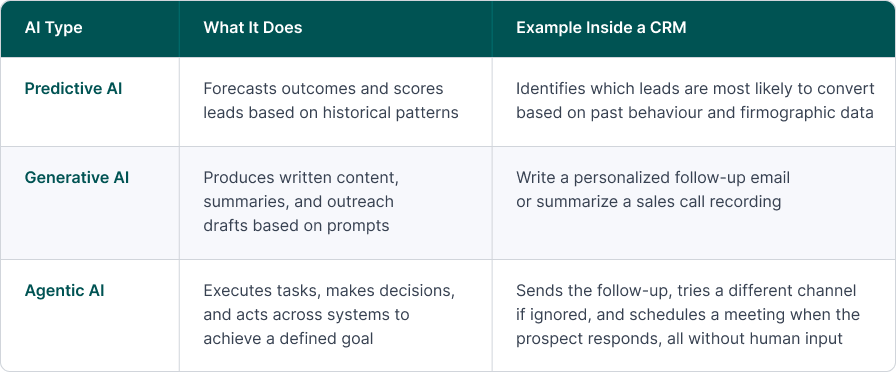
Agentic CRM combines all three layers. The predictive layer tells the agent which leads to prioritize. The generative layer drafts the message. The agentic layer actually sends it, tracks the response, and decides what happens next, all in real time, all without a rep touching the keyboard.
AI agents in CRM lead to several improvements across the sales cycle, so let’s find out how it differs from traditional CRM.
How agentic CRM drives sales: The five components that make it work
AI in CRM development is an architectural shift in how the CRM operates. Understanding what the system is built from helps you evaluate what your current platform is missing and what a build or integration would involve.
1. Connectors
These are the integrations that give agents access to every channel your sales team already works across. A well-connected AI WhatsApp CRM has bidirectional sync with email, calendar, LinkedIn, WhatsApp, Slack, and your CRM's own API.
Without these, the agent can identify the right action but cannot take it. Platforms like Pepper Cloud are already built around this multi-channel connectivity, which makes them a natural foundation for agentic sales workflows.
2. Decision nodes
These are the logic blocks that determine what the agent does at each stage of the sales cycle. A decision node might evaluate whether a lead has opened an email, whether it has been more than 48 hours since last contact, and whether the lead's company matches your ICP before choosing between three possible next actions. This is what separates intelligent follow-up from blanket sequencing.
3. Memory layer
This stores the full history of every interaction the agent has had with a lead or account. It allows the agent to pick up a sales conversation after days or weeks without losing context. Without memory, every agent action starts from scratch, and nothing kills a warm lead faster than a follow-up that reads like a first contact.
4. Goal-based workflows
Traditional CRM automation runs on triggers. Agentic CRM runs on sales outcomes. Instead of 'if form is submitted, send email,' the instruction is 'get this lead to a booked demo call within five business days.' The agent determines the route, tries alternate channels if one does not work, and adapts when the prospect's behaviour changes.
5. Data quality layer
This is the component most agentic CRM guides skip, but it is the one that determines whether the system actually moves deals forward. Agentic AI is only as accurate as the CRM data it reads from.
If contact records are incomplete, lead scores are stale, or pipeline stages are inconsistently used, the agent makes wrong calls on your best prospects, and does so at speed. A data quality audit before deployment is not optional. Every sales outcome the agent produces flows from the quality of the data underneath it.
Each component handles a specific part of the sales execution problem. Together, they turn your CRM from a system that records what your reps should be doing into one that actually does it.
 Pepper Cloud Marketing
How agentic CRM benefits sales teams in 2026
Agentic CRM completely changes what a sales team can realistically get done without adding headcount. Here are the key benefits that matter most for sales operations.
- Execution without gaps
Agentic CRM ensures that follow-ups, lead enrichment, meeting scheduling, and pipeline updates happen automatically, whether or not a rep is available to action them. Deals that would have gone cold because someone was in back-to-back calls stay in motion without any manual intervention.
- Faster speed-to-contact
Agentic CRM responds to inbound leads within minutes. Research shows that contacting a lead within five minutes is 21 times more effective than reaching out after 30 minutes, and agentic CRM makes sub-five-minute response times the default rather than the exception.
- Personalisation at scale
The agent pulls from the full contact history, firmographic data, and recent behaviour before crafting any outreach. Every message is tailored to the specific lead's context, a level of personalisation that previously required a rep's direct attention to achieve.
- More rep time on high-value conversations
Data entry, status updates, and routine follow-up sequencing account for a significant share of a sales rep's working week. When agents handle these tasks, reps redirect that time to negotiation, objection handling, and relationship-building, which is the work that actually requires human judgment.
- Real-time pipeline accuracy
Because the agent updates deal records after every interaction, the pipeline reflects what is actually happening rather than what a rep last remembered to log. Sales managers get a reliable forecast without having to chase the team for updates.
- Consistent process across every rep
A strong rep follows up three times across two channels. An average rep follows up once. Agentic CRM applies the same process to every lead regardless of who owns the account, removing the performance gap that comes from relying on individual habits and energy levels.
- AI-driven insights for smarter decisions
Because the agent is continuously reading pipeline data, it can surface patterns that a human reviewing a dashboard would miss, such as which leads are converting fastest, which outreach channels are getting the most responses, and where deals are stalling most often in the cycle.
Agentic CRM takes care of the execution that usually slips through the cracks, so your pipeline keeps moving without constant manual effort.
The result is a faster, more consistent sales process where reps spend less time managing tasks and more time closing deals.
Wrapping up
At its core, agentic CRM is about making sure things actually get done.
Most CRM systems are great at tracking what’s happening, but they still rely heavily on people to take the next step. That’s where things often slow down. Agentic CRM changes that by stepping in and handling the follow-ups, coordination, and routine actions automatically.
If implemented thoughtfully, with clean data and clear goals, agentic CRM can turn your CRM from a system of record into a system that actively drives outcomes.
Frequently asked questions
What is an agentic CRM?
Agentic CRM is a CRM system that uses autonomous AI agents to execute sales and marketing tasks without waiting for human input. Instead of creating a task for a sales rep to follow up, an agentic CRM sends the follow-up itself, adapts based on the response, and updates the deal record automatically.
Which industries benefit most from agentic CRM?
Any industry that manages a high volume of customer interactions across multiple channels benefits from agentic CRM. Healthcare providers use it for patient follow-ups, appointment scheduling, and triage routing. Real estate agencies use it for lead qualification, property matching, and viewing scheduling. Educational institutions use it for admissions outreach and student engagement sequences. Travel companies use it for enquiry response and itinerary personalisation at scale.
How long does agentic CRM implementation take?
A basic agentic workflow integrated into an existing CRM platform typically takes 6 to 12 weeks from data audit to live deployment. A fully custom agentic CRM, with bespoke decision logic, multiple external integrations, and a purpose-built data architecture, takes 4 to 8 months, depending on the number of integrations, the complexity of the workflows involved, and the quality of the existing CRM data going into the build.
Can agentic CRM work alongside human sales reps?
Yes, and this is how it is designed to work. Agentic CRM is not a replacement for human sales reps. It handles the repetitive, time-sensitive execution tasks that fall through the cracks when reps are busy: Follow-ups, lead enrichment, meeting scheduling, and pipeline updates. The human rep steps in for conversations that require relationship nuance, commercial judgement, or context that sits outside what the CRM data can tell the agent.