


Scaling conversational sales across borders
Discover how businesses use AI-powered WhatsApp CRM to manage multilingual leads, automate conversations, and scale conversational sales across borders without losing speed, context, or conversions.

Something interesting happens when a business starts running WhatsApp ads in multiple countries. The leads come in fast. The conversations start. And then everything slows down.
Not because the product is wrong or the pricing is off. It slows down because the sales team only speaks English, and the leads come in from various countries such as Brazil, Germany, Indonesia, and the UAE.
This is the reality for a growing number of SMEs using WhatsApp for business as their primary sales channel. The platform is built for conversational selling. It is personal, fast, and works across borders.
But the moment your leads start responding in Portuguese, Arabic, or Bahasa, your response time tanks and your conversion rate follows.
The multilingual WhatsApp sales problem nobody talks about
WhatsApp has over 2 billion users globally, and that is precisely why it works so well as a sales channel. Your prospects are already there. They are comfortable. They reply quickly.
But here is the catch. When you run ads targeting Germany, Mexico, and Saudi Arabia, the conversations that come in reflect the language of those markets. A prospect in São Paulo is going to type in Portuguese. A lead in Jakarta is going to respond in Bahasa. And a buyer in Dubai might switch between Arabic and English mid-conversation.
For a sales rep sitting in Singapore or London who only speaks English, that conversation is essentially dead on arrival. They can copy-paste it into Google
Translate, attempt a reply, and hope the nuance lands. But anyone who has tried selling through a translation tool knows how that ends. The tone is off. The cultural context is missing. The prospect can tell immediately they are not talking to someone who understands their market.
This is not a language problem. It is a sales operations problem. And it gets worse as you scale.
Why translation tools and chatbots are not enough
The first instinct most teams have is to layer on technology. Add a translation plugin. Build a multilingual chatbot. Set up WhatsApp automation flows that handle the initial greeting in different languages.
These tools are useful for the top of the funnel. A chatbot can qualify a lead, ask basic questions, and route them to the right pipeline. But the moment a prospect asks a specific question about features, pricing, contract terms, or implementation timelines, the chatbot hits a wall. It cannot negotiate. It does not understand the local business norms. It cannot pick up on the subtle cues that tell a good sales rep whether this deal is real or not.
Take Germany as an example. German buyers tend to be methodical. They want detailed documentation. They expect precision in how you describe your product.
A chatbot spitting out a generic translated message is not going to cut it. Or consider Brazil, where relationship-building is central to the sales process. Prospects expect warmth, follow-up, and a genuine human connection before they commit to a purchase.
The technology handles routing and qualification. The actual selling still needs to happen in the right language, with the right cultural context, by a real person.
How AI-powered CRM features are changing the game
Rather than hiring in every market from day one, modern CRM platforms now give sales teams the tools to handle multilingual conversations without needing a rep in every country.
The first is built-in AI translation. Instead of copying messages into an external tool, sales reps can translate incoming WhatsApp messages directly within the CRM. Admins configure a base language for each agent, and the system handles live translation in both directions.
A lead writes in Portuguese, the sales or customer rep reads it in English, replies in English, and the lead receives the response in Portuguese. The conversation stays inside the CRM, the context is preserved, and there is no toggling between apps.
Then there are multilingual AI agents. With a Bring Your Own AI (BYOA) approach, businesses can connect specialised AI agents directly into their CRM workflows.
These agents can qualify leads in the prospect's language, answer common questions about pricing or features, and hand off to a human rep with full conversation context. The AI handles the initial engagement while the rep focuses on closing.
The third piece is workflow automation that routes leads to the right person automatically. When a WhatsApp message comes in from a German phone number, the CRM can tag it by region, assign it to the rep who covers DACH markets, and trigger a personalised welcome message in German.
No manual sorting. No leads sitting in a general queue for hours. The right person gets the right lead at the right time.
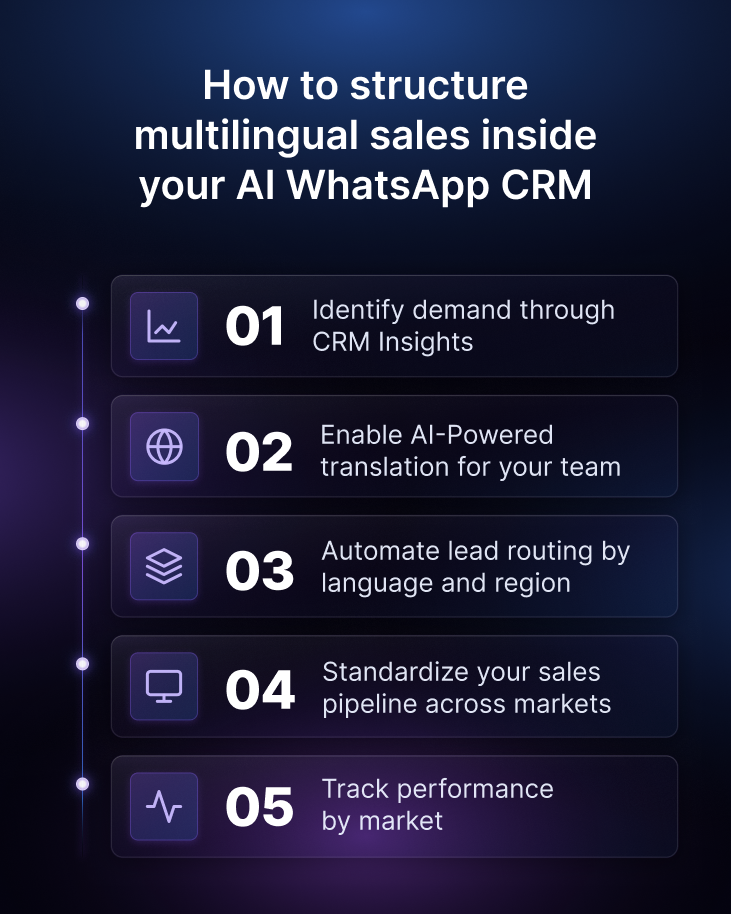
When these features are combined in a WhatsApp CRM, every conversation is tracked, every deal moves through the same pipeline, and the HQ manager has full visibility across markets and languages.
When (and if) you need local sales support
As your WhatsApp conversations scale, your CRM will start revealing patterns. You will see which markets generate the most leads, where response times are slower, and where conversation rates are lagging. This is where most businesses make a mistake.
They assume the solution is to immediately hire local sales reps. In reality, that is rarely necessary in the early stages.
With the right WhatsApp CRM in place, your existing team can already manage multilingual conversations using AI-powered features like AI language translation, AI agents, and automated workflows.
Local hiring only becomes relevant when:
- Deal sizes increase significantly
- Conversations require deep market-specific context
- Or relationship-building becomes a key differentiator
At that point, your CRM data will clearly justify the investment. If you do decide to explore global hiring solutions, independent comparison platforms can help you evaluate options across different markets based on coverage, pricing, and compliance support.
The key is to scale operations first, and only expand your team when the data supports it.
The real impact of multilingual conversational sales
The shift to multilingual sales is not just about convenience. It directly impacts revenue.
Research shows that consumers are more likely to buy when communicated with in their native language. In a channel like WhatsApp, where conversations are personal and immediate, this effect is even stronger.
When a prospect receives a response in their own language: trust is built faster, conversations flow more naturally, and decision-making becomes easier.
For businesses, this translates into: higher reply rates, faster deal cycles, and improved conversion rates.
More importantly, it helps recover opportunities that would otherwise be lost due to language gaps.
With AI-powered translation, automated workflows, and centralised conversation tracking inside a CRM, teams can unlock this value without needing to scale headcount immediately.
Instead of missing out on international leads, you are now equipped to convert them.
Scale globally from a single platform
Scaling conversational sales across borders no longer requires building separate teams in every country.
With a WhatsApp CRM at the centre of your sales operations, you can:
- Manage multilingual conversations from one platform
- Automate lead routing and follow-ups
- Maintain a consistent sales process across markets
- Gain full visibility into global performance
AI handles the language layer. Automation handles the operational layer. Your team focuses on closing. And as your data grows, you can make smarter decisions about where to invest, when to expand, and how to scale.
The result is a sales system that is not just global, but efficient, structured, and built to grow with you. Contact us today and take the next step toward efficient global sales growth.