


The vanishing email: Why customers prefer instant messaging over inboxes
Email is no longer the centre of customer communication and sales. This blog explores why instant messaging now dominates customer experience, and how AI WhatsApp CRM workflows turn conversations into conversions.

When was the last time you refreshed your email inbox waiting for a response?
And when was the last time you fired off a quick message on WhatsApp, Instagram, or a web chat and got a reply within seconds?
For most people, the difference is shocking.
Today’s customer doesn’t want to “wait for a reply.” They want answers now. They want conversations, not threads.
This behaviour is the outcome of an evolving digital world where speed, convenience, and continuity matter more than ever.
Across industries, customer interactions are quietly shifting away from traditional email and toward instant messaging platforms, creating a communication revolution shaped by expectations of immediacy and the rise of smart tools like AI chatbots, unified communication systems, and automated CRM workflows.
But how is this shift happening across different industries? Let's find out.
Why Email is losing its relevance in modern customer experience
Email was once the gold standard of professional communication. It still holds significance but not in the same way. The shift is not emotional; it is behavioural, statistical, and deeply practical.
Here’s what’s happening:
1. Response delays are no longer acceptable
Even well-managed businesses take anywhere from 6 to 24 hours to respond to an email. Many take longer.
Meanwhile, customers expect instant replies, especially when browsing products, seeking support, or asking for a quote.
A retail chain recently found that while email queries converted at around 9%, instant messaging queries converted at nearly 28%, simply because the response time dropped from hours to minutes.
Customers aren’t impatient, they are simply aligned with the speed at which digital life moves.
2. Emails get lost, filtered, or forgotten
Email inboxes are dense. Promotions, newsletters, spam, transactional updates—thousands of messages compete for attention.Even when a customer is waiting for an important reply, it can easily:
- Get buried
- End up in spam
- Be marked “read” and forgotten
- Get delayed due to internal forwarding
Compare this with messaging apps, where the conversation appears like a chat thread, simple, visible, persistent.
3. Instant Messaging Feels Human
Customers today want more than resolution, they want connection. Messaging platforms allow:
- Quick clarifications
- Voice notes
- Images, files, documents
- Emojis and reactions
- A natural conversational flow
A home-services startup noticed that support satisfaction jumped when they shifted from email-based ticketing to chat-based support. Customers said they felt like they were “talking to a real person, not submitting a request into the void.”
 Pepper Cloud Marketing
The Psychology Behind the Shift: Why Messaging Feels Better
Messaging feels better because it matches modern behavioural patterns shaped by speed, familiarity, and reduced effort.
Messaging is intimate and direct: It mirrors how customers communicate with friends and family.
It reduces cognitive load: Emails require structure. Messages require intent.
It supports multitasking: Customers can message while commuting, shopping, or working.
It creates emotional closeness: A simple “Got it, give me two minutes” message makes customers feel acknowledged—something email rarely delivers.
 Pepper Cloud Marketing
The Rise of omnichannel communication and smart CRM workflows
Behind this shift is not just customer behaviour, it is also technology.
Modern businesses aren’t using messaging apps as standalone tools. They are adopting systems that merge messaging + AI CRM + automation into one continuous workflow.
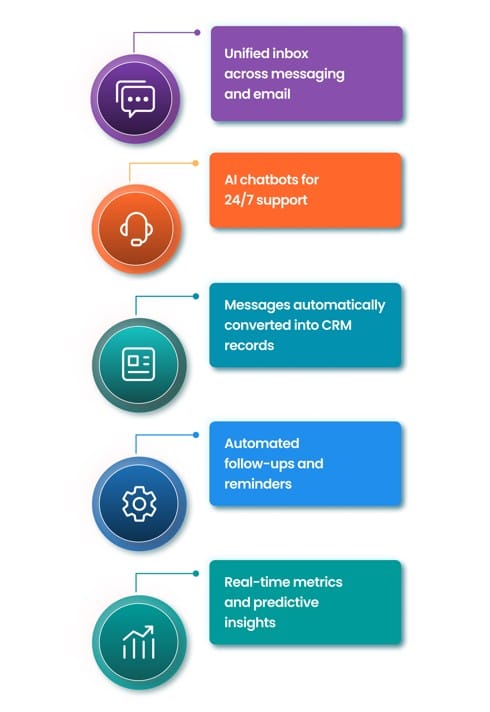
Here are the capabilities shaping this new era:
1. Unified inbox across messaging and email
Imagine viewing WhatsApp messages, website chat, email threads, Instagram queries, and SMS conversations in one place, no switching tabs, forwarding emails, or losing context.
Businesses using unified inboxes report:
- Faster responses
- Zero lost messages
- Smooth customer handovers
- Seamless tracking
This consolidation is a major reason messaging is becoming the core of customer communication.
2. AI chatbots for 24/7 Support
AI chatbots today aren’t just answering FAQs—they’re:
- Capturing leads
- Qualifying queries
- Routing conversations
- Suggesting replies
- Personalising responses based on context
- Triggering automated workflows
If a customer asks: “Is this available in medium size? ”A chatbot can instantly answer, fetch the SKU, and notify the sales team.
This level of immediacy simply isn’t possible with email.
 Pepper Cloud Marketing
3. Messages automatically converted into AI CRM records
One of the biggest transformations is that messaging conversations no longer stay “stuck” in the app. They’re automatically logged back into the sales and support CRM, creating:
- Contact profiles
- Conversation histories
- Funnel stages
- Activity logs
- Follow-up reminders
This ensures sales teams don’t have to copy-paste email threads or manually update customer information.


4. Automated follow-ups and reminders
If a customer drops off mid-conversation, the system can automatically:
- Send a follow-up message
- Trigger an email summary
- Notify the sales agent
- Push reminders into the CRM
Email alone cannot maintain such continuity without manual work.
5. Real-Time metrics and predictive insights
Instant messaging gives operational visibility that email never could.
Teams can track:
- Response time
- Conversation-to-conversion time
- Agent performance
- Drop-off points
- Keywords customers commonly use
This helps businesses refine communication, marketing, and support strategies with precision.
Real email workflows: The AI CRM shift in action
Across industries, AI CRM–driven messaging is transforming delayed email workflows into fast, conversion-ready conversations.
Case 1: A furniture brand reduced quote time from 48 hours to 15 minutes
Earlier, customer enquiries via email were routed through multiple departments before someone responded.
After shifting to instant messaging and AI WhatsApp CRM with a unified workflow:
- Sales teams received messages instantly
- Auto-qualification scripts filtered serious buyers
- Images, catalogue PDFs, and pricing were shared immediately
Result? Average response time dropped drastically, and monthly conversions increased.
Case 2: A healthcare clinic improved patient retention
Patients disliked long email forms and delayed confirmations. Messaging changed everything.
Using automated appointment reminders, quick chat confirmations, and AI-based symptom routing, the clinic experienced:
- Fewer missed appointments
- Better patient communication
- Higher satisfaction scores
Patients felt cared for through continuous conversation instead of sporadic emails.
Case 3: An education consultancy converted more leads with AI chat
Students often inquired late at night due to different time zones. Emails received after working hours went unanswered until the next day.
With messaging:
- Queries were instantly acknowledged
- AI chatbots handled basic questions
- Advisors intervened when needed
This created a smooth experience where students received clarity at their own pace.
Why customers trust instant messaging more than email
Instant messaging has become the dominant engagement layer for modern customer communication. When combined with an AI CRM, it supports real-time intent handling, contextual intelligence, and faster decision-making across the customer lifecycle.
1. Speed builds trust
Instant messaging operates in a real-time engagement window where customer intent is highest. Faster first-response time, reduced time-to-acknowledgement, and automated intent classification create immediate confidence.
2. Transparency increases perceived reliability
Messaging environments provide delivery confirmation, activity visibility, and interaction feedback loops. AI CRMs strengthen this by applying SLA tracking, response ownership, conversation status indicators, and performance analytics, which reduce uncertainty and increase operational trust.
3. Conversational continuity preserves context
Email relies on fragmented threads and static inboxes, which often break context across teams. Instant messaging maintains a single conversation timeline, while AI WhatsApp CRM applies conversation history, customer profiles, and cross-touchpoint context to every response.
4. Rich media accelerates resolution
Modern messaging supports multimedia inputs such as images, documents, audio, and location data. They use attachment parsing, image recognition, metadata extraction, and automated tagging to shorten resolution cycles and reduce back-and-forth.
5. Low-friction, human communication
Messaging removes procedural barriers and rigid formats that slow email communication. AI messaging CRM balances conversational language with policy compliance, response consistency, and quality control, delivering efficiency without sacrificing empathy.
But does this mean email is dying? Not exactly
Email still has its place, for contracts, formal documentation, compliance-related communication, and long-form product information.
The shift isn’t about removing email; it’s about reducing its role in real-time interactions. Smart businesses today use both:
- Email for structured, official, long-form communication
- Instant messaging for quick engagement and continuous customer experience
This blended approach, supported by omnichannel platforms—is what customers appreciate most.
How businesses can prepare for an AI messaging-first customer world
Here’s what businesses are doing to adapt, without overwhelming their teams:
1. Consolidating all conversations into a unified inbox: No more switching platforms or losing track of queries.
2. Automating repetitive work Such as:
- FAQs
- Appointment reminders
- Payment follow-ups
- Lead qualification
3. Adding AI-assisted responses for agents: Human teams respond faster because the system suggests context-aware replies.
4. Connecting all messaging channels to the CRM: Ensuring every conversation turns into meaningful, trackable data.
5. Providing 24/7 coverage using chatbots: Customers no longer wait for office hours.
6. Using analytics to refine customer engagement: Instead of intuition, decisions are based on real behavioural patterns.
The conversation-to-conversion advantage
One of the biggest reasons businesses are shifting toward messaging is the seamless flow from conversation to conversion.
Instant messaging closes the gap between:
- A question asked
- A response given
- A need identified
- An action taken
Within the same chat window, customers can:
- Browse catalogues
- Share product photos
- Complete payments
- Book appointments
- Receive updates
- Get support
This uninterrupted experience is something email could never replicate.
The future is not “messaging vs email” - It is intelligent communication
The world is not abandoning email; it’s evolving from it. We are moving into a reality where:
- Conversations happen instantly
- Workflows run automatically
- CRM systems update themselves
- Predictive insights guide decisions
- Multi-channel engagement happens in one place
Customers today want frictionless journeys. They don’t want to figure out how to reach you—they want you to be reachable where they already are.
And the businesses that are winning today are those embracing a more connected, conversational, and intelligent way of managing customer interactions.
Messaging is not replacing email. It’s becoming the core of customer experience.
Final thoughts
The vanishing email trend is a transformation powered by customer expectations and advancements in AI-driven communication infrastructure. As customers demand immediacy, empathy, and continuity, messaging emerges as the natural bridge between conversations and business outcomes.
Businesses that adopt smarter, unified, omnichannel communication systems are witnessing:
- Faster decisions
- Clearer communication
- Higher customer satisfaction
- Stronger conversions
In a world where attention is fleeting and experiences matter, instant messaging doesn’t just provide speed—it delivers connection. Bring WhatsApp, website chat, and social messaging into one AI-powered CRM.
Respond instantly, automate workflows, and never lose context again. Try Pepper Cloud WhatsApp AI CRM and make messaging your growth engine.
Frequently asked questions
1. What’s the difference between an email and a message?
Email is designed for formal, long-form communication and asynchronous responses, while instant messaging enables real-time, conversational interactions with immediate visibility and faster response cycles.
2. What is the main difference between email and instant messaging?
The core difference is speed and continuity, instant messaging supports real-time engagement within a single conversation thread, whereas email relies on delayed replies and fragmented inbox threads.
3. Why do customers prefer instant messaging over email?
Customers prefer messaging because it delivers quicker responses, clearer context, richer media sharing, and a more human, conversational experience compared to traditional email.
4. Can instant messaging replace email completely?
No. Instant messaging complements email by handling real-time interactions, while email remains useful for formal documentation, compliance, and long-form communication.
5. How does an AI CRM improve instant messaging for businesses?
An AI CRM centralises conversations, automates responses, preserves context, logs data into the CRM, and provides insights that help teams respond faster and convert more effectively.


