


WhatsApp calling vs standard VoIP: which CRM integration is best for your sales team?
WhatsApp Calling and Standard VoIP offer different ways to connect with customers. WhatsApp Calling suits teams that sell through WhatsApp, while Standard VoIP fits structured business calling. Learn how to choose the right CRM calling solution and manage both with Pepper Cloud.

WhatsApp Calling vs. Standard VOIP comes down to two different approaches to business calling. WhatsApp Calling connects voice calls with WhatsApp customer conversations, while Standard VoIP uses internet-based business phone systems with dedicated numbers and calling infrastructure.
For sales teams, WhatsApp Calling is better for customers who already use WhatsApp. Whereas standard VoIP is better for outbound calls, call routing, and business phone calls.
Both options can integrate with modern CRMs, but they handle customer conversations and calling workflows differently a gap that shows up in the data. Recent industry research found that 66% of sales reps feel overwhelmed by the number of tools they use, and only about a third fully utilise their tech stack. A sales team that chooses the wrong fit can end up with disconnected conversations, unnecessary switching between tools, or calling features it rarely uses.
What is WhatsApp calling?
In business, WhatsApp Calling is the voice-calling feature integrated into the WhatsApp Business Platform. It connects directly to the same Cloud API that businesses currently use to send template messages and process webhooks in their Chats, so that calls are not considered a separate line of communication, but rather as an event within the existing conversation.
For example, a customer messages a real estate company on WhatsApp asking about the price and availability of a property. After exchanging a few messages, the customer wants to discuss the property in more detail.
Instead of asking the customer to switch to a separate phone number, the salesperson can use WhatsApp Calling to continue the conversation through a voice call.
This makes WhatsApp Calling particularly useful for businesses whose sales and customer interactions already happen through WhatsApp.
Here are the key characteristics of WhatsApp Calling
- End-to-end encrypted: Voice calls are secured using the same encryption as WhatsApp messages.
- Two-way initiation: Either the business or the customer can start the call, and businesses can set permissions and calling windows to control when they're reachable.
- These are accessed via the Business Platform: companies access most of these through a Business Solution Provider (BSP), as most will not use the free consumer WhatsApp Business app because it is built on the Cloud API.
- Ideal for WhatsApp-first countries: In countries where users already lean on WhatsApp to reach businesses (most of South and Southeast Asia, Latin America, Middle East regions, etc.), this bridges the gap between "let's hop on a call" and "on a call.
What is standard VoIP?
Standard VoIP is an ordinary business telephone system that transports voice communications via the internet instead of a standard circuit-switched landline. It's delivered over cloud PBX and SIP trunking, usually provided by a dedicated provider like Aircall, RingCentral, Zoom Phone, KrispCall, or Twilio.
For example, let's say there is a sales team that consists of 20 salespeople who call out to prospects daily. All salespeople have a business number in the company's VoIP system and can make calls from a computer or mobile device.
Incoming calls can also be directed to the appropriate system, and the activity of the calls can be recorded and made available to the manager to monitor what team members are doing when they interact with customers.
This enables the company to use calling as a formal sales process rather than individual cell phones.
Key characteristics of standard VoIP are:
- Dedicated numbers, independent of any app: Businesses get local or toll-free numbers that work over a softphone, desk phone, or mobile app and reach anyone with a phone number, whether or not they use WhatsApp.
- Mature call-centre features: IVR menus, voicemail, click-to-dial, warm transfer, and all other call-centre features are standard, not add-ons.
- Provider-based billing: These costs are usually based on the number of minutes spent or the number of seats used and are determined by the VoIP provider and not the messaging provider.
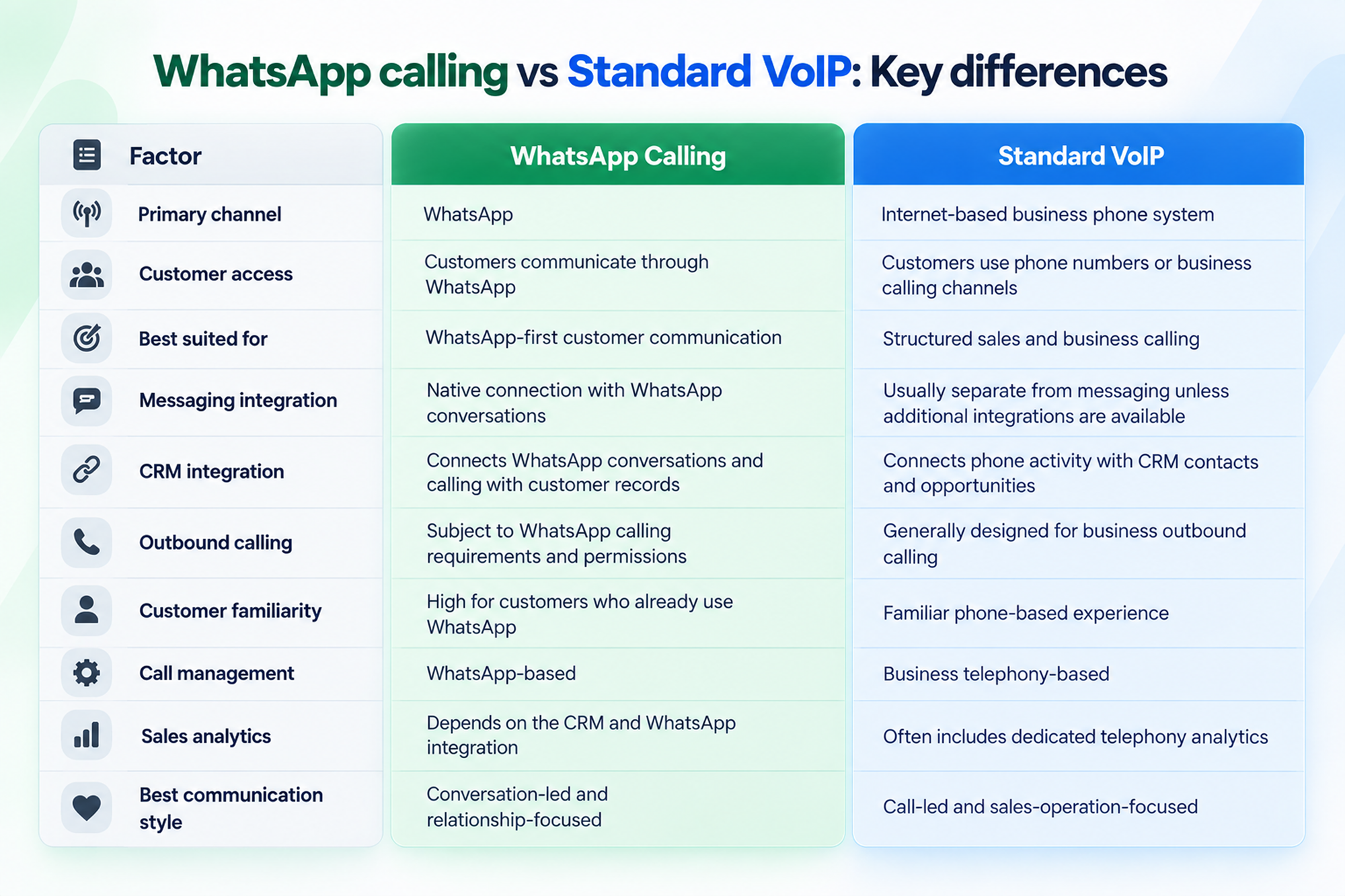
WhatsApp calling vs standard VoIP: Key differences
How to choose the right CRM calling solution for your sales team?
1. Consider where your customers prefer to communicate
WhatsApp Calling within AI CRM can make the sales process seem more natural if the majority of your customers are on WhatsApp. A salesperson can follow up on the channel they started the conversation on, rather than asking the customer to go into a different phone call.
Example:
A real estate company receives property enquiries through WhatsApp. A potential buyer inquires about an item, communicates with a real estate agent and then requests the salesperson to talk about the price. WhatsApp Calling enables a conversation to shift from chat to voice without the need to switch the customer to another application.
Select WhatsApp Calling when:
Your customers already use WhatsApp a lot, and your sales process begins with WhatsApp conversations.
2. Consider your calling volume and workflow
Your team's volume and type of calls should also be a factor in your decision.
If the sales team is making a few calls to follow up on some warm leads, it probably doesn't require a full-fledged VoIP system. But a team with hundreds of outbound calls requires more than just these features, including IVR, call routing, dedicated numbers, call queues, and structured call management.
Example:
A B2B sales organisation has 20 outbound sales representatives working on outbound calls all day long. The team should route calls, keep track of activity, and handle many calls to deal with. In this case, Standard VoIP might be more suitable.
Use Standard VoIP when:
High-volume business calling or Structured Business Calling is an important part of your sales operation.
3. Consider inbound vs. outbound calling
WhatsApp Calling can prove to be very beneficial when a customer already communicates with your business using WhatsApp and desires to proceed the chat by phone.
Outbound sales teams can be structured and work with contact lists, making repeated business calls, which is where standard VoIP might be more appropriate.
Example:
A customer sends a message on WhatsApp to a travel agency to enquire about a travel package. The salesperson can follow up on that conversation and progress to a call, as needed.
Conversely, if a software company has a sales team that dials hundreds of prospects from a lead list, they will likely be better off with a separate VoIP system.
4. Check CRM integration and call logging
Don't simply inquire if the calling solution integrates with your CRM. Check what information actually gets captured.
The ideal CRM integration should be easy for salespeople to use and allow them to quickly access customer data, log calls, make notes, and follow up on leads without having to log into several systems.
Example:
Now, suppose a salesman has just completed a 15-minute conversation with a prospect. When the call activity and information are automatically synced to the prospect's CRM record, the salesperson can move on to the next step without having to manually enter the information into another system.
Look for:
- Call activity logging
- Customer/contact information
- Call notes
- Follow-up tracking
- Call history
- Recording support, if applicable
- Contact and opportunity association
5. Check geographic availability and regulations
Availability of WhatsApp Calling features, business calling requirements, and local regulations may vary from market to market. There are also country-specific needs for standard VoIP with regard to phone numbers, caller ID, telecom laws and number provisioning.
Example:
If a company has to use local business numbers and a traditional phone-based customer experience, they might want to consider VoIP when expanding itstheir sales operation to a different country.
In areas where WhatsApp Calling is available and allowed, a business with existing customers who primarily use WhatsApp for their communications may find WhatsApp Calling more convenient.
The important thing to check is availability and regulatory requirements before selecting a calling channel for a market.
6. Compare the total cost at your expected volume
Avoid comparing the price of WhatsApp Calling and VoIP mentioned in the ads. Look at the total cost of your actual calling workflow.
Consider:
- Number of calls
- Call duration
- Number of users/seats
- Calling destinations
- Existing CRM costs
- Provider charges
- WhatsApp/Meta pricing
- Additional telephony features
For example, a small sales team with occasional customer calls may have different requirements from a 50-person outbound sales team making thousands of calls every month.
How does Pepper Cloud AI WhatsApp CRM support both WhatsApp calling and standard VoIP?
Pepper Cloud supports both WhatsApp Calling and Standard VoIP within its AI WhatsApp CRM, allowing sales teams to manage customer conversations, calls, and follow-ups from a single platform
With WhatsApp Calling integration in CRM, sales representatives can make and receive WhatsApp calls directly. Calls remain part of the same conversation with the customer on WhatsApp, allowing teams to handle chats, calls, and customer information from one place.
For standard VoIP, Pepper Cloud integrates with calling platforms such as Aircall and KrispCall. These integrations enable teams to make and receive calls from the CRM, automatically log call information, view customer details, and monitor call activity in one place, without having to switch systems.
This will present businesses with two practical choices:
- WhatsApp Calling: Useful for customers who are already using WhatsApp for communication.
- VoIP: More appropriate for teams that use a specific business phone service for sales and support.
Pepper Cloud integrates both WhatsApp Calling and VoIP into the CRM, allowing sales teams to maintain a consistent flow of customer conversations and calling activity rather than dealing with them in disparate tools.
By supporting both calling options, Pepper Cloud AI WhatsApp CRM gives sales teams the flexibility to work around the way their customers prefer to communicate. Teams can stay on WhatsApp when conversations already happen there, or use VoIP when business calls are managed through dedicated calling platforms.
This means teams don’t have to force every customer interaction into the same channel; they can choose the calling method that fits the conversation while keeping their customer activity connected to the CRM.
Final Thoughts
WhatsApp Calling and standard VoIP both offer useful ways to connect with customers, but the right choice depends on how your sales team communicates. With Pepper Cloud, you can use both calling options in one CRM, making it easier to manage customer conversations, calls, and follow-ups without switching between different tools.
Ready to bring WhatsApp Calling and Standard VoIP into your sales workflow? Manage customer conversations, calls, and follow-ups from one place with Pepper Cloud's AI WhatsApp CRM solutions. Book a demo and see how your sales team can connect customer communication with CRM workflows, keep call activity organised, and manage conversations across channels from a single platform.
Frequently asked questions
1. Is WhatsApp Calling free to use?
Ans: The pricing for calls between a business and a customer inside WhatsApp is determined by Meta and your Business Solution Provider, and may be different from the traditional per-minute VoIP pricing and may vary by market. Check the latest rates with your provider before scaling up your calls.
2. Does Standard VoIP work internationally?
Ans: Yes. While most countries and regions support the provisioning of VoIP numbers, local telecom regulations and caller ID requirements differ from country to country, and should be verified on a market-by-market basis.
3. Can a CRM support both WhatsApp Calling and VoIP at the same time?
Ans: Yes, a CRM system that integrates the WhatsApp Business Platform and a phone-system connector allows reps to engage in a conversation across whichever channel is most appropriate and have both activities recorded in the same contact record.
4. Is WhatsApp Calling suitable for outbound sales calls?
Ans: WhatsApp Calling can support business calling, but outbound calls are subject to applicable WhatsApp requirements, permissions, and availability. Sales teams that depend heavily on structured outbound prospecting may find Standard VoIP more suitable for their calling workflow.
5. Does Standard VoIP require customers to use WhatsApp?
Ans: No. Standard VoIP uses business phone numbers, so customers can communicate with the business through a regular phone call without using WhatsApp. This makes VoIP useful when a sales or support team needs to reach customers through traditional phone-based communication.