


How agentic AI is redefining CRM sales workflows for SMEs
Agentic AI is no longer a concept reserved for enterprise giants SME sales teams are now using autonomous AI agents inside their CRMs to qualify leads and manage pipelines without manual effort.

Your sales team is spending hours doing work that a machine could handle in seconds. Logging calls, chasing cold leads, sending the same follow-up email for the fifth time, updating CRM fields after every meeting these tasks drain capacity that should go into building relationships and closing deals.
For small and medium-sized businesses (SMEs), this problem is even more acute. Unlike large enterprises, you cannot simply hire more people to absorb administrative overhead. Every hour counts, and every missed follow-up is a deal at risk.
Agentic AI changes this equation entirely. Unlike basic automation or simple AI-powered suggestions, agentic AI takes independent action reasoning through tasks, making decisions, and executing multi-step workflows autonomously inside your CRM. It does not just prompt your team to act; it acts on your behalf.
What is agentic AI and how is it different from basic AI?
Most sales teams have already encountered AI in some form. The AI WhatsApp CRM might suggest the next best action, flag an at-risk deal, or auto-fill contact information. These are useful features, but they are fundamentally assistive they require a human to read the suggestion and decide what to do.
Agentic AI works differently. An AI agent is a system that perceives its environment, sets goals, plans a course of action, and executes that plan, often across multiple tools and systems, without waiting for human instruction at every step.
Here is a simple comparison:
In a CRM context, this means an AI agent can pick up a new inbound lead, look up their company profile, assess fit against your ideal customer profile, assign a score, route them to the right sales rep, draft a personalised outreach email, and schedule a follow-up all without a human touching the keyboard.
 Pepper Cloud Marketing
Five ways agentic AI is transforming CRM sales workflows for SMEs
1. Autonomous lead qualification
Qualifying leads manually is one of the most time-consuming activities in a sales cycle. Sales reps must cross-reference multiple sources, check company size, assess budget signals, and determine whether a lead is worth pursuing a process that can take 20 to 30 minutes per lead.
Agentic AI compresses this into seconds. An AI agent connected to your sales CRM can pull data from the lead record, cross-check against firmographic databases, review website behaviour data, assess engagement history, and produce a qualification score with a written rationale automatically.
For SMEs running lean sales teams, this means reps begin every day with a pre-prioritised pipeline rather than spending the first two hours of their morning figuring out where to focus.
2. Intelligent follow-up sequences
Follow-up is where most deals are won or lost, and it is also where most sales teams fall short. Research consistently shows that it takes six to eight touchpoints to convert a prospect, yet the majority of sales reps give up after two.
Agentic AI solves this by taking ownership of the follow-up sequence. Rather than sending templated emails on a fixed schedule, an AI agent monitors the prospect's behaviour whether they opened the last email, clicked a link, visited a pricing page, or went quiet and adjusts the next touchpoint accordingly.
The agent can draft personalised messages, select the appropriate channel (email, WhatsApp, or a CRM task for the rep), set the timing based on engagement signals, and log every interaction automatically. The sales rep is only brought in when the prospect is warm and ready for a conversation.
3. Real-Time pipeline management and forecasting
Pipeline reviews in most SMEs are a monthly exercise involving manually updated spreadsheets, stale CRM data, and a lot of guesswork. Agentic AI turns pipeline management into a continuous, live process.
An AI agent can monitor every deal in the pipeline in real time tracking days since last contact, stage duration, engagement signals, and deal size and flag risks before they become losses. If a deal has been stagnant in the proposal stage for 12 days with no response, the agent does not wait for the next pipeline review. It alerts the rep, suggests a re-engagement approach, or takes action directly.
Beyond monitoring, agentic AI can produce rolling revenue forecasts based on live pipeline health rather than static monthly snapshots giving SME leaders a more accurate picture of where the business stands at any moment.
4. Automated CRM data hygiene
Dirty CRM data is one of the most persistent problems in B2B sales. Duplicate records, outdated contact details, missing fields, and inconsistent naming conventions erode trust in the system leading sales reps to bypass the CRM altogether and keep their own spreadsheets.
Agentic AI tackles this at the source. An agent running continuously in the background can merge duplicate records, enrich contact profiles by pulling from external data sources, update deal stages based on email and calendar activity, and flag records that are missing critical information.
The result is a CRM that stays clean without anyone manually maintaining it which means the data you rely on for forecasting, reporting, and coaching is actually trustworthy.
5. Cross-System workflow orchestration
Sales workflows rarely live inside a single system. A deal moves from CRM to proposal tool, to e-signature platform, to finance system, to onboarding workflow. For SMEs without dedicated operations staff, orchestrating these handoffs manually creates delays, errors, and dropped balls.
An agentic AI system can act as the connective tissue across these tools detecting when a deal reaches a certain stage, triggering the relevant downstream action in another system, and updating the CRM with the outcome. A prospect who signs a proposal can be automatically moved to onboarding, assigned to a customer success rep, and welcomed with a personalised message all without a single manual step.
 Pepper Cloud Marketing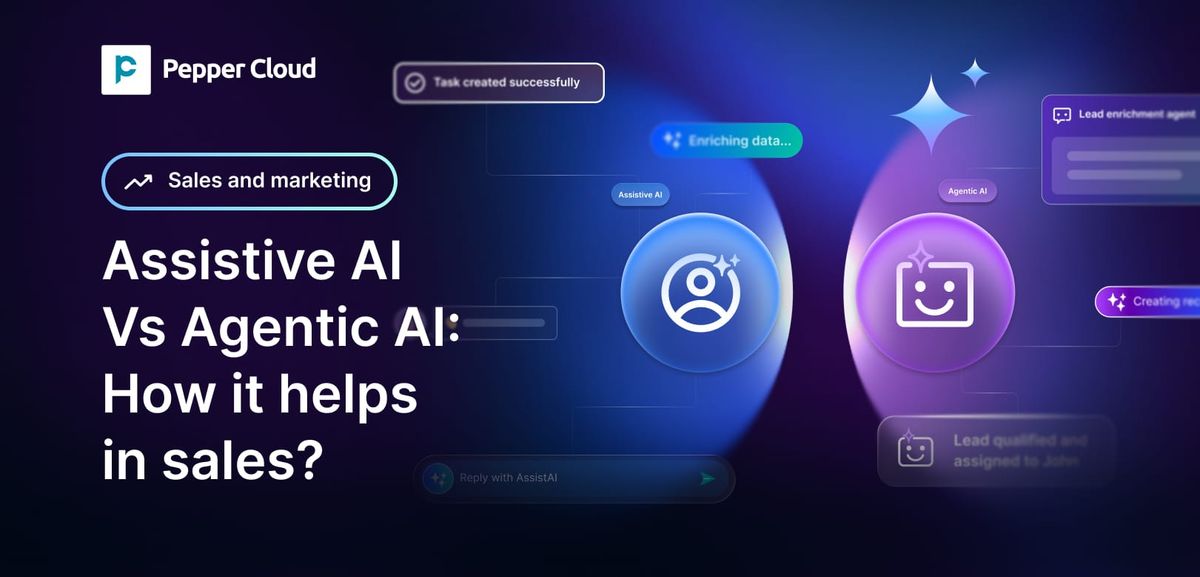
Agentic AI in practice: A day in the life of an SME sales team
To make this concrete, consider a manufacturing SME with a six-person sales team.
Before implementing agentic AI within their CRM, each rep spent approximately two hours per day on administrative tasks updating records, researching leads, chasing unresponsive prospects, and preparing pipeline reports for the weekly sales meeting.
After deploying an AI agent connected to their CRM, the workflow changed substantially. Every morning, the AI agent delivers each rep a prioritised list of deals to focus on, with a brief summary of where each prospect stands and a suggested next action.
New inbound leads from the website are qualified, scored, and assigned before the rep even opens their laptop.
During the day, the agent handles follow-up emails for prospects who have not responded, updates deal stages when emails are replied to, and flags deals that are showing signs of stalling. The pipeline review, which used to take 90 minutes, is now a 20-minute conversation because all the data is current and the risks are already highlighted.
What SMEs should look for in an agentic AI-ready CRM
Not every CRM is ready for agentic AI. As you evaluate your options or assess your current setup there are several capabilities worth looking for:
• Native AI agent support: Look for platforms that offer built-in agentic capabilities rather than requiring third-party bolt-ons. Salesforce Agentforce, for instance, enables businesses to deploy AI agents that work natively within Salesforce CRM data and workflows, reducing integration complexity significantly.
• Open API architecture: Your CRM must be able to connect with the other tools in your stack email, calendar, proposal software, finance system — so the AI agent can orchestrate workflows across systems rather than just within one.
• Configurable guardrails: Agentic AI should operate within boundaries you define. Look for platforms that allow you to set rules around what the agent can and cannot do autonomously, and what must be escalated to a human.
• Audit trails and transparency: Every action taken by the AI agent should be logged and reviewable. This is not just good governance, it is essential for coaching, compliance, and building team trust in the system.
• Scalable data model: As your use of agentic AI grows, the volume of data being processed increases. Your CRM needs a data architecture that can handle this without performance degradation.
The key advantage of working with a specialist implementation partner is that they bring both the technical expertise to configure the AI correctly and the sales process knowledge to ensure the agent is actually doing the right things, not just automating bad habits at speed.
Common misconceptions SMEs have about agentic AI
Before moving forward, it is worth addressing some of the most common hesitations:
• "It will replace my sales team." Agentic AI replaces tasks, not people. It handles the repetitive, low-value work so your team can focus on what humans do best: building relationships, navigating complex negotiations, and exercising judgment in ambiguous situations.
• "It's only for large enterprises." This was true three years ago. Today, platforms like Salesforce offer modular, scalable agentic AI capabilities that SMEs can adopt incrementally, starting with one workflow and expanding as confidence grows.
• "Our data isn't clean enough." Ironically, agentic AI is one of the best tools for improving data quality. Agents can clean and enrich data as they go, so a messy CRM is often the starting point rather than a barrier.
• "We don't have the technical resources to manage it." Modern agentic AI platforms are designed to be configured through natural language and visual builders rather than code. Working with a qualified implementation partner further reduces the internal technical burden.
Getting Started: A Practical Approach for SMEs
The most effective way to introduce agentic AI into your CRM sales workflow is to start narrow and expand. Trying to automate everything at once creates complexity and resistance. Instead, identify the single most painful, repetitive task in your current sales process and build your first AI agent around that.
A practical starting sequence:
1. Audit your current workflow - Map out where your team spends time on non-selling activities. Quantify the hours lost to administration, follow-up, and data entry.
2. Identify your highest-impact starting point - Lead qualification and follow-up sequences typically offer the fastest return for SMEs because they are high-volume and highly repetitive.
3. Choose a CRM platform with native agentic AI capability - Avoid platforms that require extensive third-party integrations to enable basic agent functionality.
4. Define clear guardrails - Decide upfront what the agent can do autonomously and what must involve a human. Start with narrow permissions and expand as trust grows.
5. Measure and iterate - Track the time saved, the change in response rates, and the impact on pipeline velocity. Use this data to justify the next wave of workflow automation.
The competitive advantage is widening act now
Agentic AI is not a future technology. SMEs in competitive B2B markets are already deploying it, and the gap between early adopters and those waiting on the sidelines is growing every quarter.
The sales teams that will win over the next three years will not necessarily be the largest or the most experienced. They will be the ones that use AI agents to operate with the speed, consistency, and precision that no manual process can match while their reps focus exclusively on the human interactions that close deals.
The technology is ready. The business case is clear. The question is whether your team is prepared to lead the shift or respond to it.
Key takeaways
• Agentic AI goes beyond traditional automation by reasoning, deciding, and executing multi-step tasks independently inside your CRM without constant human instruction.
• For SMEs, the highest-impact use cases are lead qualification, follow-up sequence management, and real-time pipeline monitoring, all areas where manual effort is high and consistency is low.
• Agentic AI replaces repetitive tasks, not salespeople. It frees your team to invest time in high-value activities: relationship building, complex negotiations, and strategic account management.
• Choose a CRM with native agentic AI support. Platforms like Salesforce Agentforce integrate AI agents directly into your existing sales data and workflows, reducing complexity and accelerating time to value.
• Start narrow. Identify one high-volume, repetitive workflow, deploy your first agent, measure the results, and expand from there. The SMEs seeing the best outcomes are those that iterate quickly rather than trying to automate everything at once.
FAQs
Q1. What is the difference between agentic AI and traditional CRM automation?
Traditional CRM automation follows fixed, rule-based triggers for example, sending a welcome email when a lead is added. Agentic AI goes several steps further. It reasons through context, makes decisions, and executes multi-step workflows independently such as qualifying a lead, assigning it to the right rep, drafting a personalised follow-up, and updating the pipeline all without waiting for human input at each stage.
Q2. Is agentic AI only suitable for large enterprises with big budgets?
Not at all. While agentic AI was once primarily an enterprise-level capability, platforms like Salesforce Agentforce now offer modular, scalable options that SMEs can adopt incrementally. You can start with a single workflow such as lead qualification and expand as your confidence and results grow, without a large upfront investment.
Q3. Will agentic AI replace my sales team?
No. Agentic AI replaces repetitive, low-value tasks logging calls, chasing cold leads, updating CRM fields not the people doing them. The goal is to free your sales reps from administrative overhead so they can spend more time on what genuinely requires human skill: building relationships, navigating complex negotiations, and closing deals.
Q4. What should SMEs look for in a CRM platform before adopting agentic AI?
There are a few key things to evaluate. First, look for native agentic AI support rather than requiring third-party integrations. Second, ensure the platform has an open API architecture so the agent can orchestrate workflows across your other tools. Third, check that it offers configurable guardrails so you control exactly what the agent can do autonomously and full audit trails so every AI action is logged and reviewable.
Q5. How do SMEs typically get started with agentic AI in their CRM?
The most effective approach is to start narrow. Identify the single most painful, repetitive task in your sales process lead qualification and follow-up sequences are the most common starting points for SMEs. Deploy your first agent around that one workflow, measure the time saved and impact on pipeline velocity, and then expand from there. Trying to automate everything at once tends to create resistance and complexity.