


WhatsApp sales funnel: A complete guide
Learn how to build a WhatsApp sales funnel that turns enquiries into paying customers. This guide covers the four funnel stages, a 9-step setup process, lead qualification, CRM automation, follow-ups, and key metrics, plus best practices to keep every conversation helpful and consistent.
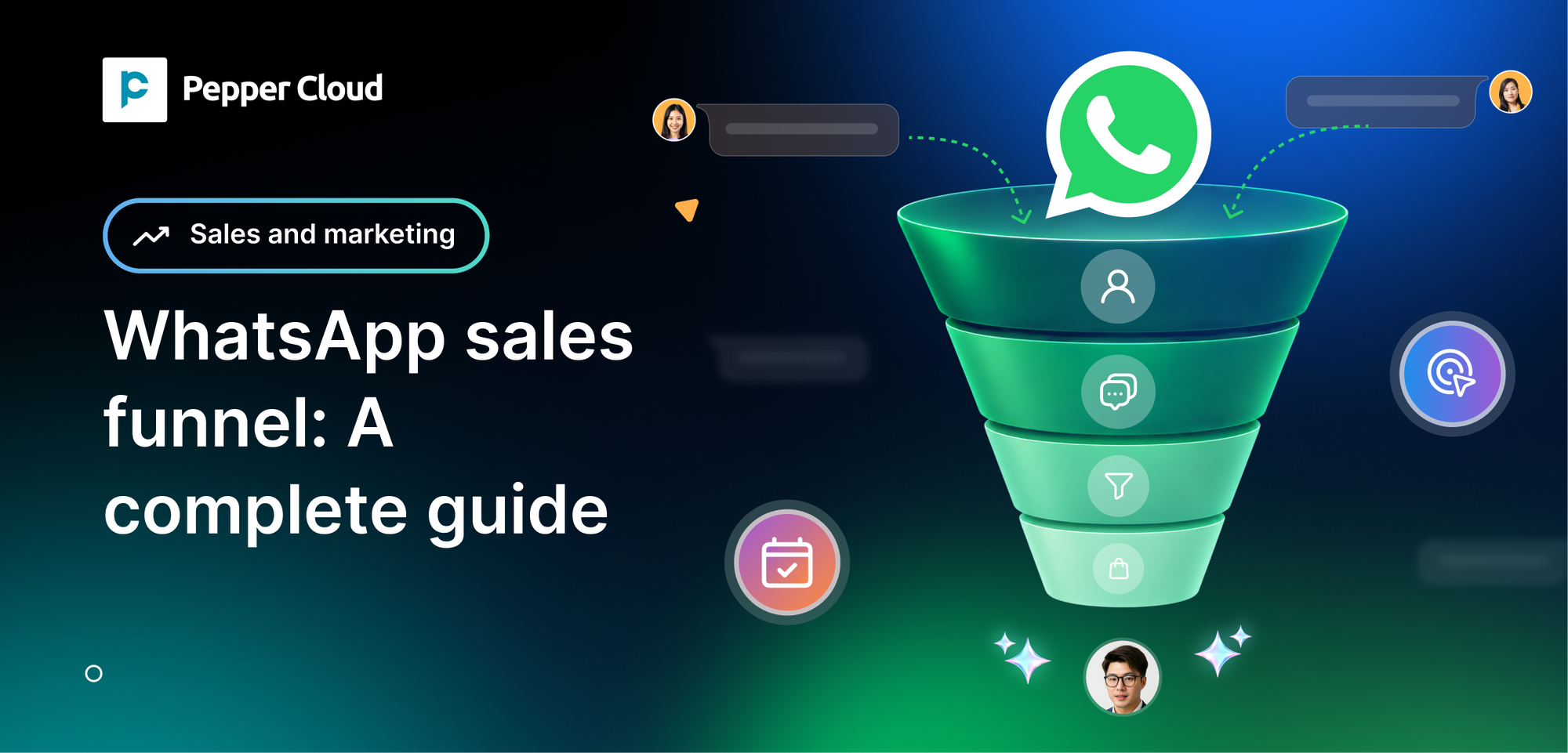

A WhatsApp sales funnel is a process designed to help businesses convert leads into paying customers through WhatsApp. It guides prospects from their first enquiry to purchase by sharing relevant product information, offering personalised recommendations, answering questions and following up at the right time.
This allows you to guide your buyers from initial contact to final purchase and helps your sales team manage leads.
WhatsApp can be used to help answer any questions about your product, get to know your customer, provide product information, book appointments, send quotes and follow up with interested leads.
When integrated with a CRM system, it can help your team keep track of leads, automate repetitive tasks and track sales.
The most important part of a sales funnel is to provide your customers with the correct information at every stage.
Too long? Read this
- A WhatsApp sales funnel helps businesses capture leads, qualify prospects, convert them into customers, and encourage repeat purchases.
- Start by defining your target audience and sales goals, then set up WhatsApp Business to suit your team's needs.
- Create clear entry points through your website, social media, QR codes, and advertisements to attract potential customers.
- Ask relevant questions to qualify leads and share product information, pricing, or demos based on their buying stage.
- Use CRM automation to assign leads, schedule follow-ups, manage sales stages, and reduce repetitive tasks.
- Track response times, lead qualification, conversion rates, and revenue to identify gaps in your sales funnel.
- Personalise messages, follow WhatsApp's messaging policies, and provide customers with clear next steps throughout their buying journey.
Why use WhatsApp for your sales?
WhatsApp helps businesses connect with potential customers, answer product questions, and guide them towards a purchase through direct messaging.
It also makes it easier for sales teams to capture leads, follow up on enquiries, and manage sales opportunities. Here’s how WhatsApp supports your sales process.
Benefits of using a WhatsApp sales funnel
Having a structured WhatsApp sales funnel will help your business create a consistent process to attract new prospects, gain an understanding of what they need, convert quality leads and build long-term relationships.
What are the key stages of a sales funnel
A WhatsApp sales funnel consists of 4 stages:
1. Awareness – Top Of Funnel (TOFU)
What happens:
Potential customers become aware of your business and what your products/services can provide for them.
How they can become aware:
Website links, social media posts, click-to-WhatsApp advertising and QR codes.
Why it’s important:
To attract the right people to your business and get them to reach out on WhatsApp.
2. Interest – Middle Of Funnel (MOFU)
What happens:
Potential customers will look into your offering, ask questions and consider if they want to go ahead with your offering.
How they can become interested:
Send product catalogues, answer questions, qualify leads, and offer product demonstrations.
Why it’s important:
Build trust, understand what they need as a customer and identify good leads.
3. Decision – Bottom Of Funnel (BOFU)
What happens:
Interested potential customers will compare your offerings, look at pricing and make a decision to purchase from your business.
How they can make a decision:
Sending quotations, overcoming objections, setting up consultations and following up on decisions.
Why it’s important:
Overcome any objections and help qualified leads make a purchase.
4. Conversion – After Purchase
What happens:
Potential customers will make their purchase and become customers. You will continue to engage with them to encourage them to make further purchases.
How they can convert:
Order confirmation, sending product advice, asking for feedback and sending reminders for renewals.
Why it’s important:
Finalise sales, build relationships and create repeat business.
1. Capture more quality leads
A WhatsApp sales funnel lets interested visitors easily message your business through links on your website, QR codes, social media, and ads.
Upon receiving a message from a prospect, your team can ask relevant questions to gain an understanding of what they need.
2. Shorten the sales process
Customers often hesitate to make a purchase if they cannot find any information about the product. With WhatsApp, your sales team will be able to provide them with information about the product, pricing, demonstrations, catalogues and quotations.
This removes any extra steps and makes it easy for interested prospects to move towards making a purchase.
3. Consistent follow-up
If there is no structure in place, your sales reps may forget to follow up with prospects that have asked for a quotation.
Using a sales funnel will provide clear points to follow up. Using reminders in your CRM and automations will ensure your team follow up with prospects at the right time.
4. Minimise repetitive tasks
Automations can be used to greet the prospect, answer common questions, qualify leads and ask for appointments. Enquiries can also be routed to the correct sales rep based on the customer's needs.
This will save you time and allow your sales team to focus on providing product consultations, negotiating and closing deals.
5. Track your sales
Having a structured sales funnel will make it easier to see where prospects are dropping off. If you are receiving a high amount of enquiries but few quality leads, this might be an indication that your advertising is targeting the wrong audience.
If you are receiving lots of quotations but few completed sales, this could be due to pricing issues, poor follow-ups, or unaddressed objections. By tracking each stage of the sales process, you can identify and address these issues.
6. Encourage repeat sales
A sales funnel doesn’t end once a customer has made a purchase. You can use WhatsApp to update them on their order, provide guidance on the product, remind them to renew, ask for feedback and provide relevant offers.
With their permission, you can use this to build relationships and encourage repeat sales.
How to build a WhatsApp sales funnel?
Creating an effective sales funnel on WhatsApp requires you to know your target audience, set clear entry points, qualify your leads, plan your next steps and track your results.
Follow these steps to create your funnel
Step 1: Know your target audience and sales goals
Know who you are targeting and what you would like your funnel to achieve.
For example, an online retailer may have the goal of increasing sales of their products, while a B2B Software company may want to increase their product demos and qualified sales opportunities.
Know who you are targeting by considering:
- Industry, location and customers.
- What product or service they need.
- What their budget and purchasing power is.
- When they are likely to purchase and how interested they are.
- What their common questions, issues and concerns are.
Set some clear goals for your funnel. Maybe you want to increase your qualified leads, increase your product demos, improve your response times or increase the percentage of enquiries that convert to sales.
Having clear goals will help you decide which stages to include in your funnel and what to track.
Step 2: Set up your WhatsApp
Decide on how you want to set up your WhatsApp.
A small team with a reasonable amount of enquiries may be able to use the WhatsApp Business App; however, if you require multiple salespeople, automation, lead allocation and reporting, then using the WhatsApp Business Platform with a CRM may be beneficial.
Set up your business profile with accurate contact details, opening times, description and product information.
Create some welcome messages, FAQs and clear instructions to contact your salesperson. Make sure you test the whole process before advertising your WhatsApp number.
Step 3: Create entry points to capture leads (TOFU)
Your funnel needs clear entry points where potential customers can begin a conversation.
Use suitable channels to encourage interested prospects to message your business:
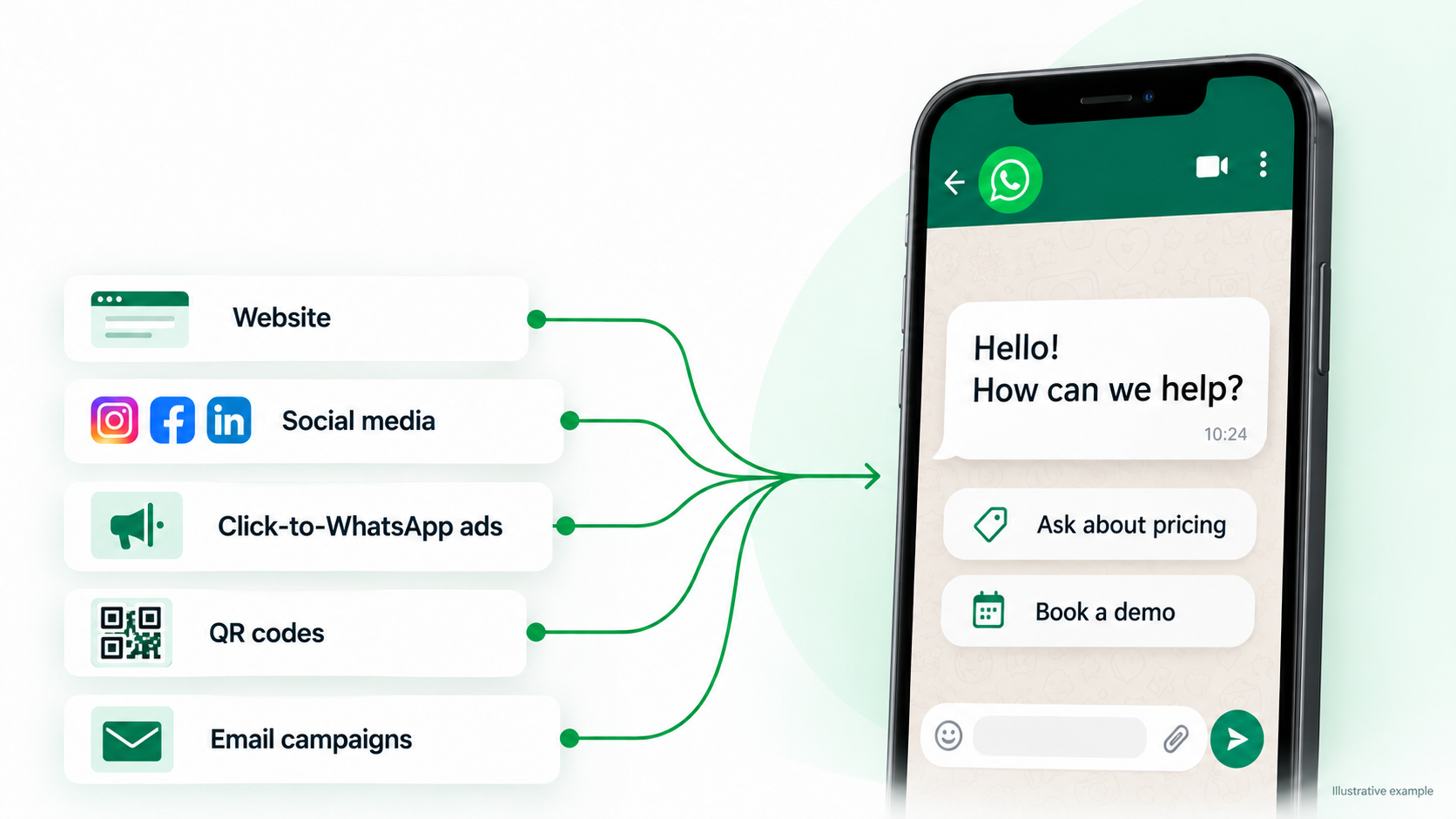
- Website: Add WhatsApp calls to action to product pages, pricing pages, and contact pages.
- Social media: Include your WhatsApp link in relevant profiles and promotional posts.
- Click-to-WhatsApp ads: Direct interested users from advertisements on supported platforms into a WhatsApp conversation.
- QR codes: Place QR codes on product packaging, brochures, storefronts, or event materials.
- Email campaigns: Include a WhatsApp link for prospects who prefer messaging over email.
- Existing customers: Invite customers to contact your business through WhatsApp for relevant product information or future purchases.
Make the next step clear. Instead of simply writing “Contact us,” use a specific call to action, such as “Ask about pricing” or “Book a product demonstration.”
Capture lead details with the customer's permission and record the source of each enquiry. This helps you understand which channels bring in qualified prospects.
Step 4: Qualify your leads (MOFU)
Not everyone will be ready to purchase, so you may need to ask them a few quick questions to understand their intent. Depending on your business, you may want to ask:
- What product/service are you looking for?
- What issue are you looking to solve?
- What is your budget?
- When are you looking to purchase?
- Would you like product information, pricing or a demo?
Don’t ask too many questions. Ask for the information you need to know to advise them on the next step.
Use a chatbot to collect some basic information and answer any common questions. Qualified prospects can then be passed on to your salesperson. If they have complex requirements, then allow them to speak to a real person.
Look into WhatsApp automation to help collect your leads and follow up. This will help you to know what can be automated without making the purchasing process feel impersonal.
Step 5: Provide relevant information
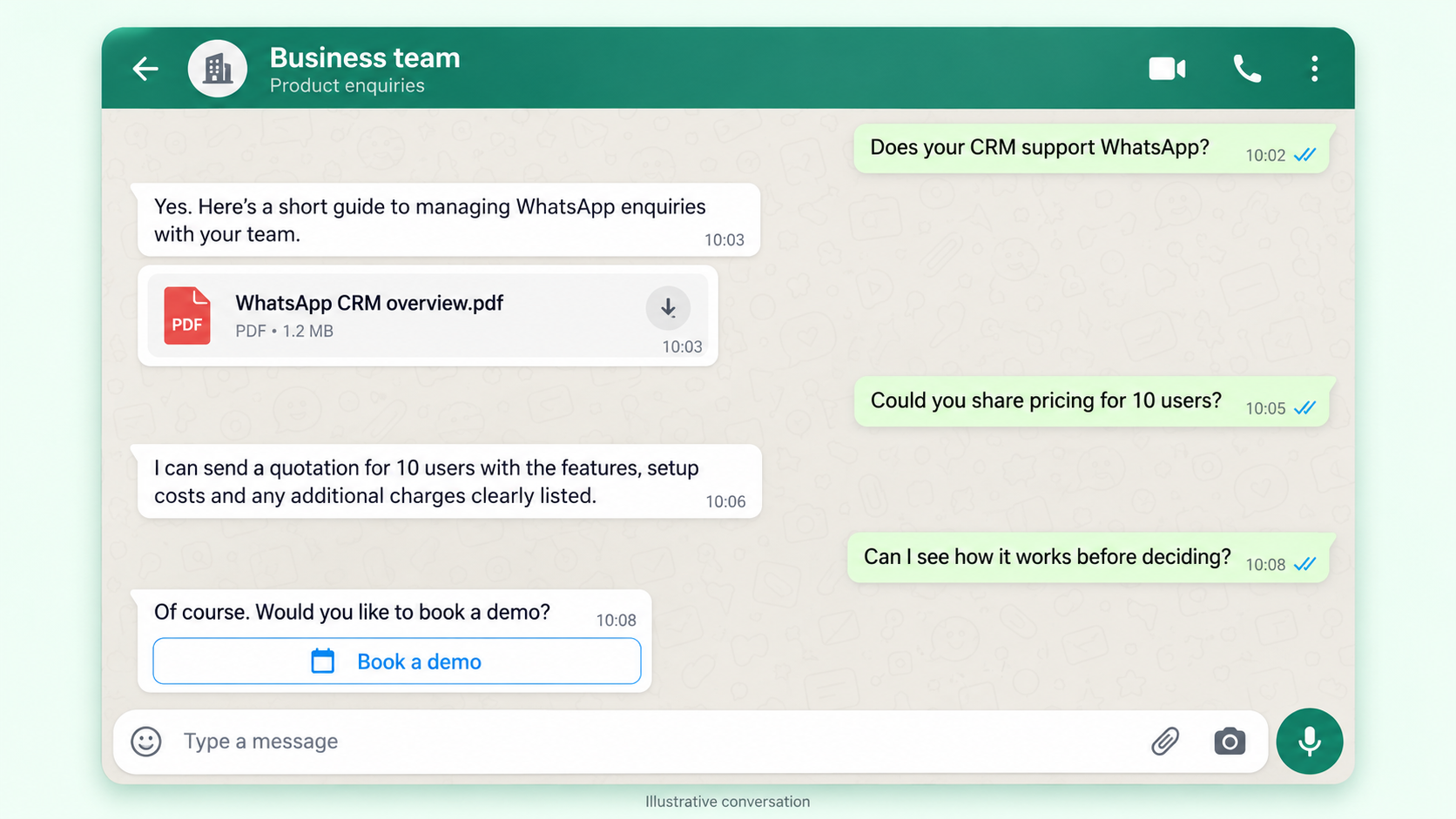
Once you have qualified your prospects, provide them with some information to help them make a decision. This should depend on their interests and where they are in the purchasing process.
For example:
If they are in the early stages, provide them with an informative guide, an overview of your product or how your solution works.
If they are interested, provide them with relevant information about the features, pricing, comparisons or answer their questions.
If they are high intent, provide them with a demo, consultation, quotation or link to purchase.
If they need more time, provide them with useful information and address their questions.
Be specific with your information. If they ask about pricing, they aren’t going to want a general introduction to your company. They need clear information about the product, pricing and what is included.
Keep your messages short and to the point. Ensure you have the correct permissions to send proactive marketing messages. Follow the rules of WhatsApp messaging.
Step 6: Convert interested prospects into customers (BOFU)
At the conversion stage, help prospects take the final step towards purchasing.
Depending on your sales process, this may involve sending a quotation, arranging a consultation, sharing a payment link, confirming product availability, or explaining the next steps.
Address objections directly. If a prospect is concerned about price, explain the value and available options. If they are unsure about implementation, clarify the process and provide relevant evidence, such as a customer case study.
Use a specific call to action, such as “Would you like me to arrange a demonstration this week?” This gives the prospect a clear next step without putting unnecessary pressure on them.
Record the outcome in your CRM, including whether the deal is won, lost, or still pending. For pending deals, schedule a suitable follow-up rather than leaving the opportunity untracked.
Step 7: Automate follow-ups and lead management
As the number of enquiries grows, manually tracking every prospect becomes difficult. Automation can help maintain consistency throughout the funnel.
For example, you can configure workflows to:
- Assign incoming leads to the appropriate sales representative.
- Send a welcome message after a new enquiry.
- Create follow-up tasks when a quotation is shared.
- Notify representatives about leads that have not received a response.
- Update lead stages when specific actions are completed.
- Send approved reminders when appropriate.
A CRM also helps teams view contact details, previous interactions, deal stages, and upcoming tasks in one place.
Explore CRM workflow automation to understand how connected sales processes can reduce repetitive work and improve lead management.
Automation should support the sales team, not replace every interaction. Give prospects an easy way to reach a person when they have complex questions or need individual assistance.
Step 8: Follow up after the purchase
Post-purchase communication helps customers get value from what they bought and creates opportunities for future sales.
Depending on the product or service, your team can send order confirmations, onboarding instructions, setup guidance, delivery updates, or product usage tips.
You can also request feedback, ask for a review, or recommend complementary products when they are genuinely relevant.
For subscription businesses, suitable renewal reminders can help customers avoid interruptions. Retailers may send replenishment reminders when customers are likely to need another purchase.
Keep these messages relevant and respect customer preferences. The goal is to build a useful ongoing relationship, not to turn every interaction into another sales pitch.
Step 9: Measure results and improve the funnel
Review your sales funnel regularly to understand what is working and where prospects are dropping off.
Track metrics such as:
- Lead capture rate: The percentage of visitors or campaign recipients who initiate a WhatsApp enquiry.
- Lead qualification rate: The percentage of captured leads that meet your qualification criteria.
- Response time: How quickly your team responds to incoming enquiries.
- Appointment or demo booking rate: The percentage of relevant leads that book a meeting.
- Conversion rate: The percentage of leads that become paying customers.
- Average sales cycle: The time it takes to move a prospect from initial enquiry to purchase.
- Revenue generated: The sales revenue attributable to your WhatsApp funnel.
- Repeat purchase rate: The proportion of customers who purchase again during the period measured.
Use these results to identify specific improvements. If many leads abandon the conversation during qualification, reduce unnecessary questions. If qualified leads do not convert, review your follow-up process and common objections.
Test one meaningful change at a time so you can understand what improves performance.
Best practices while building a WhatsApp sales funnel
Follow these practices to make your WhatsApp sales funnel useful, consistent, and customer-friendly.
1. Personalise your messaging
Ensure you personalise your recommendations by using the information shared by your prospects. You should consider their needs and what questions they have asked previously.
2. Keep your messages concise
When sharing complex information, break it down into manageable pieces. Ensure you are only providing your prospects with the information they need to decide then. If they want more information, you can offer this.
3. Plan your follow-up
Ensure you follow up with your prospects based on where they are in the buying process and what interactions you have had with them. Don’t spam your prospects if they have not responded.
4. Ask for permission and follow guidelines
Ensure you have the correct permission to send any proactive messages. Ensure you follow the guidelines set by WhatsApp and ensure you are using approved message templates. If they want to opt out, make sure you respect this quickly.
Review the official WhatsApp Business Platform policies to understand messaging requirements, approved templates, and automation rules.
5. Use automation but provide support
Automate simple questions, capturing leads and reminders. Provide support for negotiating, complex needs and judgement.
6. Track your leads
Ensure you track where your leads came from, what qualification they have, what stage of the deal they are in and what follow-ups are required. This will help your sales reps understand the opportunity and reduce duplication and irrelevant outreach.
7. Include clear CTAs
Ensure each message has a clear CTA. Ask them to select a product, provide a need, book a meeting or confirm if they want a quotation.
8. Review performance regularly
Ensure you are monitoring your funnel metrics and customer feedback. Improve any areas which are underperforming rather than just increasing the number of messages you are sending.
Conclusion
A WhatsApp sales funnel helps businesses turn enquiries into sales through a structured process of lead capture, qualification, nurturing, conversion, and post-purchase follow-up. Its effectiveness depends on understanding customer needs, providing relevant information, and making the next step easy.
Start by creating clear entry points, qualifying leads with relevant questions, and following up consistently. As your sales volume grows, connect WhatsApp with a CRM to organise lead records, automate routine tasks, and track conversions.
Most importantly, focus on helping customers make informed buying decisions. When every message serves a purpose, and every lead receives appropriate attention, WhatsApp can become a more organised and measurable sales channel.
FAQs
1. How is a WhatsApp sales funnel different from a traditional sales funnel?
A WhatsApp sales funnel guides prospects towards a purchase through direct messages, personalised recommendations, and follow-ups. Traditional sales funnels may rely more on emails, phone calls, or website forms.
2. What are the key stages of a WhatsApp sales funnel?
The key stages are lead generation, lead qualification, lead nurturing, conversion, and post-purchase engagement. Each stage helps move prospects closer to a purchase and build lasting customer relationships.
3. Can a WhatsApp sales funnel be fully automated, or does it need human involvement at certain stages?
A WhatsApp sales funnel can automate welcome messages, lead qualification, and follow-up reminders. Human involvement is still valuable for complex questions, negotiations, and personalised sales discussions.
4. How do you measure conversion rates at each stage of a WhatsApp sales funnel?
Divide the number of prospects who progress to the next stage by the number who entered the current stage, then multiply by 100. Track lead qualification, demo bookings, and purchases to identify where prospects drop off.
5. What are the WhatsApp Business API limitations that affect how you build a sales funnel?
Businesses must follow WhatsApp's messaging policies and obtain the required opt-in. Outside the 24-hour customer service window, business-initiated messages generally require approved message templates. Messaging limits and pricing may also affect funnel design.
6. How do you attract and capture leads at the top of a WhatsApp sales funnel?
Use website links, social media, QR codes, and Click-to-WhatsApp ads to encourage prospects to message your business. Ask relevant qualification questions, record lead details with permission, and follow up based on their needs.