


An Overview of Enterprise Development Grant (EDG)
Learn what is Enterprise Development Grant (EDG), EDG grant eligibility criteria, and how to apply for an EDG grant.

Important update: From 30 September 2026, Singapore’s Enterprise Development Grant (EDG), Productivity Solutions Grant (PSG) and Market Readiness Assistance (MRA) Grant have been replaced for new applications by the EDGE Grant. Businesses with EDG applications submitted before this date and existing EDG-funded projects can continue under the original scheme’s requirements, including the applicable claim process. For new projects, businesses should explore the EDGE Grant in Singapore.
Are you an SME looking to develop deeper capabilities, scale up, and internationalise your business?
Now you can do so with the help of the Singapore government’s grant - Enterprise Development Grant (EDG)!
In this article, we shall mainly focus on grants for software projects to automate your business process. These types of applications can be filed under the category of - Innovation and Productivity - Automation. Before we understand the eligibility criteria and the procedure to apply for EDG, let’s understand what EDG is.
What is EDG grant Singapore?
Enterprise Development Grant (EDG) is one of the Singapore grants that is aimed to help companies to upgrade their business, innovate or venture overseas. The EDG grant is a combination of the Capability Development Grant (CDG) and Global Company Partnership (GCP).
Previously, the CDG grant was offered by SPRING Singapore and the GCP grant was offered by International Enterprise Singapore (IE Singapore). EDG grant is a by-product of the merger between both entities.
What businesses are supported by the EDG grant?
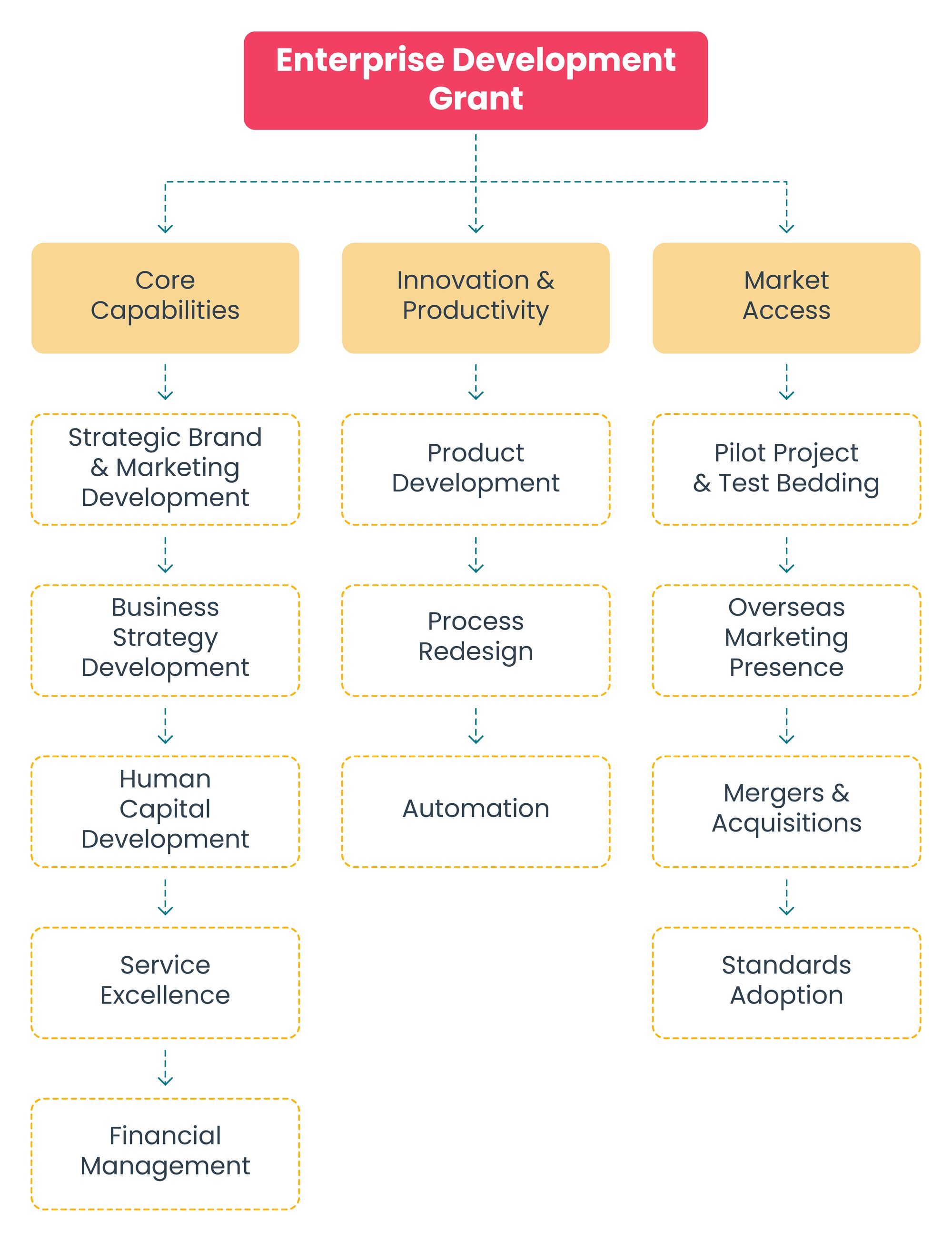
EDG, a government grant for SMEs and non-SMEs, is applicable to three categories and each category has specific project areas which are supported.
- Core Capabilities: Strategic brand and marketing development, Business strategy development, Human capital development, Service excellence and financial management.
- Innovation and Productivity: Product development, Process redesign and automation.
- Market Access: Pilot project and test-bedding, Overseas marketing presence, Mergers and acquisitions, and Standards adoption.
However, the software costs that are supported under the Productivity Solutions Grant (PSG) are not supported under the EDG grant.
Important: These categories describe the former EDG framework. Businesses planning new projects must check the EDGE Grant’s current list of supportable activities rather than assuming that an activity previously covered by EDG remains eligible under the new scheme.
What is the EDG grant amount? Is there a cap on funding?
Under the former EDG scheme, eligible small and medium-sized enterprises (SMEs) could receive up to 50% of eligible project costs. Certain sustainability-related projects had different support arrangements during specified periods.
Non-SMEs could receive up to 30% of eligible costs under the former scheme. The actual support offered depended on the project, the applicable funding rules and Enterprise Singapore’s assessment.
EDG was project-based, so there was no guarantee that an application would receive the maximum support rate. Companies needed to demonstrate that their proposed projects were relevant, feasible and supported by a suitable business case.
For a new project in 2026, do not use the former EDG funding rates to estimate your potential grant support. Under the EDGE Grant, eligible businesses can receive up to S$100,000 in total grant support per financial year across eligible activities. The applicable support rate and conditions depend on the activity selected. Refer to the official EDGE Grant information for current details.
Am I eligible for an EDG grant?
Before you initiate the EDG grant application, you should know the EDG grant eligibility criteria.
To qualify for the grant, your business entities must fulfil the following EDG grant criteria:
- The company should be registered and must be operating in Singapore.
- The company should have a minimum of 30% local shareholding.
- The company should be in a financially viable position to start and complete the project.
Meeting these criteria did not guarantee approval. Enterprise Singapore assessed applications based on factors such as the proposed project’s scope, expected outcomes and service provider’s capabilities.
For new applications, businesses should check the current eligibility criteria for the relevant EDGE Grant activity, as the requirements may differ from those under EDG.
What are the documents required for the EDG application?
If you are eligible and you are keen to apply for the EDG grant, get ready with the necessary documents.
Here is a list of required documents for filing an EDG application successfully.
- A project proposal in the specified format
- Latest ACRA information (not more than six months old)
- Audited fInancial statements
- Quotation for the project from the vendor
- Relevant consultants’ certification
Here is an EDG application checklist shared by Enterprise Singapore.
EDG grant application: How to apply?
The following steps explain the former EDG application process. They are provided for reference and for businesses managing applications submitted before 30 September 2026. New projects must now be assessed under the EDGE Grant framework.
Here are the steps for application:
Login to the EDG grant portal
If you have your documents ready and you are all set to apply for the EDG, log into Business Grants Portal and submit your application.
Accept Letter of Offer
After your application is processed, log into the Business Grants Portal and accept the Letter of Offer. Letter of offer will mention the amount of grant approved. It will also mention project deliverables and the project qualifying period.
If the Letter of Offer is not accepted during its validity period, it will expire.
Continue with your Project
Complete your software implementation and training in a stipulated time frame.
File for Claim
If you are ready to submit your claim, ensure that your company meets these criteria:
- The company has used the solution mentioned in the application.
- The company has paid in full for the solution.
- The company has submitted all the below mentioned documents.
After the approval of claims, disbursements can be made.
Documents Required during Claim Process
- Invoice and Receipts from the vendor
- Project summary report in specified template form
- Documentation of project deliverables as mentioned in the project proposal
- Bank statement confirming payment is made to the vendor in full.
This step applies to historical EDG applications. The portal is also used for EDGE applications, but applicants must select the appropriate current grant activity and follow its instructions.
How to submit EDG grant claims?
- Log into Enterprise Singapore Grants Portal
- Upload above mentioned documents
- Select an auditor from the pre-qualified panel who will audit your claims
- Submit the claim application
- After a claim is submitted, an EDG officer may contact you if clarifications are required regarding project deliverables. Similarly, the selected auditor may also contact you to verify the claims
Once the claim is processed, the amount will be transferred to your company-designated account using GIRO.
Existing EDG projects continue to be processed under their original scheme requirements following the transition to EDGE. For official guidance, refer to Enterprise Singapore’s EDG page.
EDG vs PSG vs EDGE: What Is the Difference?
EDG and PSG served different purposes under Singapore’s former grant framework. EDGE is the current framework for new applications following the transition on 30 September 2026.
The key distinction is that EDG focused on eligible business transformation projects, while PSG supported the adoption of specified productivity solutions. EDGE brings support under a new framework with its own activities, eligibility requirements and funding limits.
Top Most Frequently Asked Questions
1. What is the Enterprise Development Grant (EDG)?
The Enterprise Development Grant (EDG) was a Singapore government grant that helped businesses upgrade their capabilities, improve productivity, innovate and expand overseas. From 30 September 2026, EDG has been replaced by the EDGE Grant for new applications.
2. What is the difference between EDG and the EDGE Grant?
EDG supported individual business transformation projects, while the Productivity Solutions Grant (PSG) supported the adoption of specified pre-approved productivity solutions and equipment. The Market Readiness Assistance (MRA) Grant supported eligible overseas expansion activities.
EDGE brings these three grant schemes together under one framework, helping businesses find support for eligible activities such as digitalisation, business efficiency and internationalisation.
3. Can businesses still apply for EDG in 2026?
No. New EDG applications closed on 29 September 2026. From 30 September 2026, businesses must explore the EDGE Grant for new projects. Applications submitted under EDG before the transition will continue to be assessed under the relevant scheme requirements.
4. How much funding can businesses receive under EDG and EDGE?
Under the former EDG scheme, eligible SMEs could receive up to 50% of qualifying project costs, while non-SMEs could receive up to 30%, subject to the applicable conditions. Under EDGE, businesses can receive up to S$100,000 in total grant support per financial year across eligible activities.
5. How are EDG and EDGE grant payments disbursed?
For an existing EDG project, follow the requirements in the original Letter of Offer. For EDGE projects, submit the claim after completing the approved activity and making full payment, together with the required supporting documents. Disbursement is subject to claim approval.
6. Should a business apply for EDG or EDGE for a CRM implementation?
New CRM projects should be assessed under EDGE rather than EDG. The appropriate funding route depends on the CRM solution, the proposed project scope and the relevant supportable activity.
How can Pepper Cloud help you?
We, at Pepper Cloud CRM, help you avail all applicable grants and assist in transforming your sales process by implementing CRM. You can mould and digitise your business operations while we take care of all the grant-related paperwork. Get in touch with us for a free consultation.
Want to know SME grant updates? Subscribe to our blog and we will ensure to keep you updated!