


How long does EDGE Grant approval take in Singapore?
The EDGE Grant approval timeline in Singapore depends on your chosen business activity and vendor.Learn how long approval takes, track your application, understand common reasons for delays or rejection, and discover how to reapply and plan your project while avoiding unexpected costs.

The EDGE grant approval timeline in Singapore depends on the type of activity your business applies for.
According to Enterprise Singapore’s official EDGE Grant FAQ’s, processing time may take up to 1 week for applications involving pre-approved vendors and 10 weeks for non-pre-approved vendors.
However, the processing time for other activities may be different, so businesses should check the activity page before planning their project
Key takeaways
- EDGE Grant approval timelines vary by activity: Processing may take around 1 week for eligible pre-approved integrated ERP solutions and up to 10 weeks for non-pre-approved ERP solutions.
- Check the processing time for your specific activity: EDGE covers multiple business areas, and timelines may differ depending on the proposed project and assessment requirements.
- Track your application through the Business Grants Portal: Log in using your company's authorised Corppass account and monitor portal notifications and registered emails for updates.
- Respond promptly to document requests: Complete supporting documents, clear project details and timely responses can help avoid unnecessary assessment delays.
- Do not assume funding is guaranteed: Avoid committing to project expenses before approval unless your business is prepared to bear the costs if the application is unsuccessful.
- Review your Letter of Offer after approval: Check the approved grant amount, project qualifying period, deliverables and conditions before proceeding.
- Grant payment follows project completion and claim approval: After the claim is approved, disbursement may take up to 14 working days through PayNow Corporate or up to 8 weeks through GIRO.
- You can consider reapplying after rejection: Review the rejection reasons, correct the issues and ensure your revised application meets the relevant EDGE Grant requirements.
What is the processing time for different EDGE Grant activities?
Singapore EDGE Grant covers 8 major business areas along with 150 different activities
EDGE combines three earlier grants in Singapore: the Productivity Solutions Grant (PSG), Enterprise Development Grant (EDG), and Market Readiness Assistance (MRA) Grant. It supports different business activities,
The processing time may differ depending on the scale and the chosen activity
Here is a breakdown of the processing timelines for different types of EDGE Grant activities:
Pre-approved versus non-pre-approved vendors
A pre-approved vendor may be suitable when the business can find a package that meets its operational requirements. However, a shorter processing timeline should not be the only factor in choosing a solution.
The business must still consider the required functions, implementation needs and eligible costs. Review business grant information to learn more about grant-supported business solutions.
A non-pre-approved vendor may be appropriate when the available packages do not meet the company's needs.
In this case, the business should review the activity requirements carefully and prepare the requested supporting information before applying.
For integrated ERP solutions, the selected solution must include at least three core functions from the eligible categories.
These can include financial management, human resources management, supply chain and inventory management, and sales and customer relationship management.
How can you check your EDGE Grant application status?
You can check your EDGE Grant application status through the Business Grants Portal (BGP). Follow these steps to review your application.
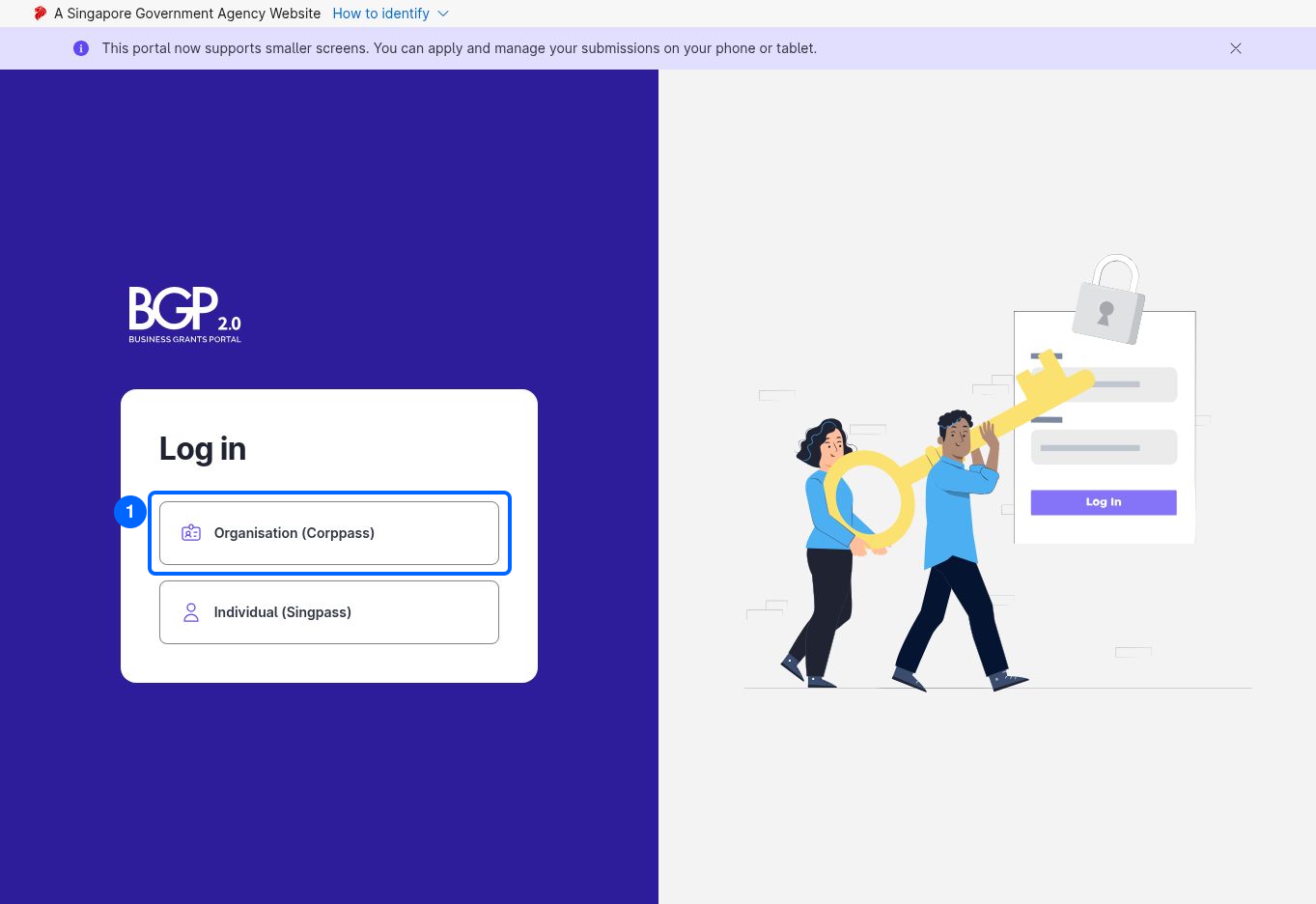
1. Log in to the Business Grants Portal
Visit the Business Grants Portal and sign in using your company's authorised Corppass account. Make sure you have the required access to view the grant application.
2. Find your EDGE Grant application
Open the relevant application in the portal. Check the application details to confirm that you are viewing the correct submission.
3. Review the latest application updates
Check the status displayed in the portal for any updates on your application. If Enterprise Singapore needs more information, review the instructions and note any required action.
4. Check for emails from Enterprise Singapore
Check the email account registered with your application for notifications, requests for supporting documents or updates about the assessment. Respond promptly if further information is requested.
5. Contact Enterprise Singapore if you need help
If you cannot find your application status or your application has exceeded the published processing time, contact Enterprise Singapore through its official website. Keep your application reference number ready so you can explain your query clearly.
Why is your EDGE Grant application delayed?
Your EDGE Grant application may take longer than expected if Enterprise Singapore needs more information or additional time to assess your project. The processing time also depends on the activity you have selected.
Businesses preparing for government funding can refer to the guide to Singapore government grants for broader context.
Here are some common reasons your application may be delayed, and we also mentioned what you can do in the meantime
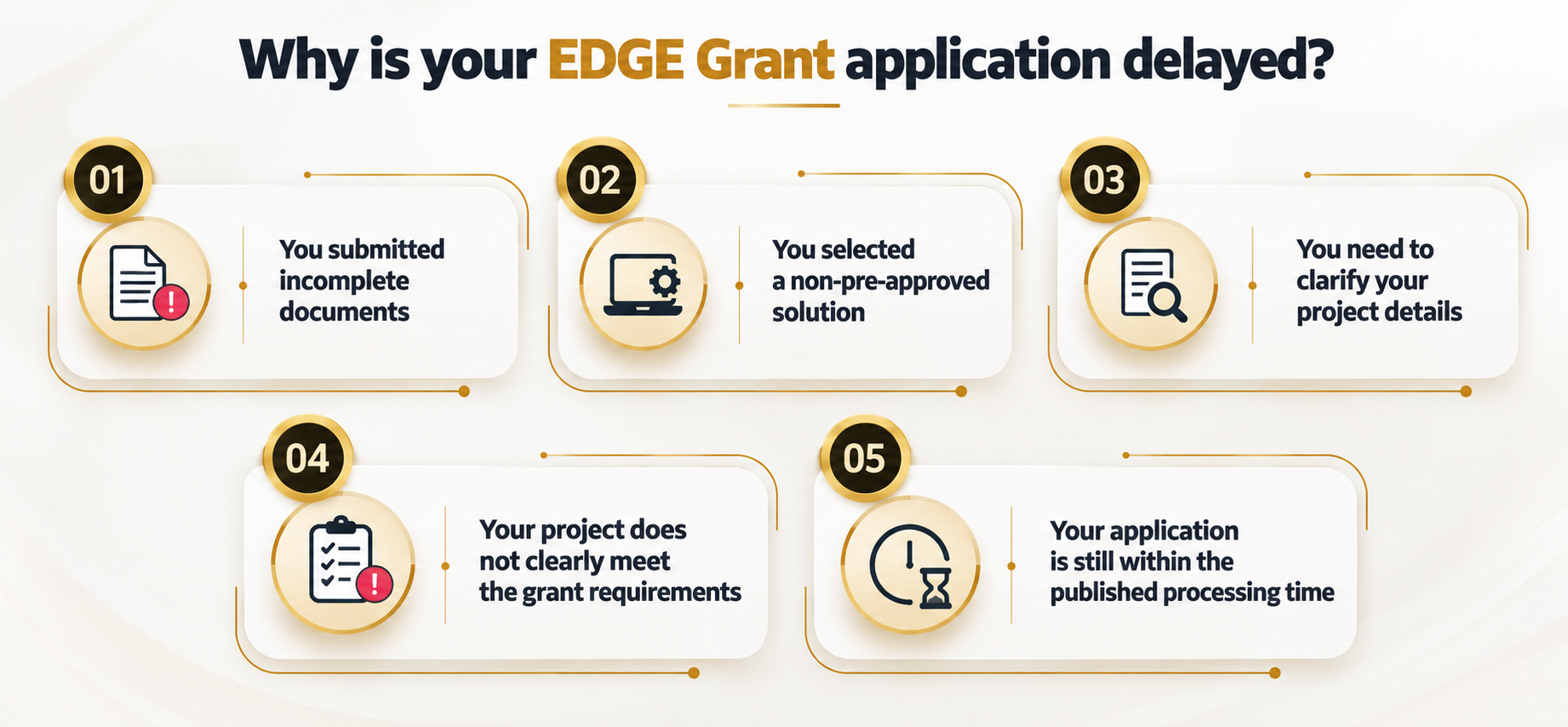
1. You submitted incomplete documents
If you missed a required document or provided unclear information, Enterprise Singapore may need to ask you for more details before assessing your application.
What you can do: Review the document requirements for your selected activity. Make sure your business details, project proposal, quotations and other supporting documents are complete before submitting them.
2. You selected a non-pre-approved solution
If you choose a non-pre-approved solution for an integrated ERP project, your application takes longer to process than one using a pre-approved solution.
Enterprise Singapore lists the processing time as 1 week for pre-approved ERP vendors and 10 weeks for non-pre-approved ERP vendors.
What you can do: Check whether an eligible pre-approved solution meets your business needs. If you need a custom solution, plan your project timeline around the longer assessment period.
3. You need to clarify your project details
Enterprise Singapore may contact you through the Business Grants Portal (BGP) if it needs clarification about your proposed activity.
What you can do: Check your BGP notifications and registered email regularly. If you receive a request, provide the information requested as soon as possible to help the assessment proceed.
4. Your project does not clearly meet the grant requirements
Your application must meet the eligibility criteria and requirements for the activity you selected. If your project scope or proposed solution does not clearly match those requirements, further clarification may be needed.
What you can do: Review the eligibility criteria and supported activities on the official EDGE Grant website. Make sure your application explains what you plan to do and how the project meets the selected activity's requirements.
5. Your application is still within the published processing time
Not every application delay means something is wrong. Some activities require more assessment time than others, so your application may still be under review.
What you can do: Check the published processing time for your specific activity. If that period has passed and you have not received an update, contact Enterprise Singapore for clarification.
What should you do if Enterprise Singapore requests more documents?
If Enterprise Singapore requests additional documents, read the request carefully and respond through the specified channel. The request may concern the project scope, vendor selection, costs, eligibility or other information needed to assess the application.
Use the following approach:
- Identify each document or clarification requested.
- Check that the information relates to the correct application and proposed activity.
- Ensure figures, quotations and project details are consistent with the original submission
- Submit the requested material through the channel specified by the agency.
- Keep a record of the submission and monitor the portal and registered email for further updates.
Avoid sending unrelated documents in place of the requested evidence. If a requirement is unclear, ask Enterprise Singapore for clarification rather than making assumptions.
A request for additional information does not automatically mean that an application will be rejected. The outcome depends on the assessment and whether the application meets the relevant grant requirements.
What happens if your EDGE Grant application is rejected?
If your EDGE Grant application is rejected, review the reason for the decision before submitting a new application.
You may be able to apply again, but you need to address the issues with your previous submission and make sure your project meets the grant requirements.
1. Understand why your application was rejected
Check the rejection notice to understand why your application was unsuccessful. The issue may relate to your company's eligibility, the proposed project or whether the activity meets EDGE's requirements.
Your next step: Review the rejection details and compare your application with the requirements listed on the official EDGE Grant website.
2. Check whether your project meets EDGE requirements
Before applying again, make sure your proposed project fits an eligible EDGE activity. Enterprise Singapore states that projects that do not align with the grant's purpose or have already commenced will not be supported.
Before you reapply: Review the activity requirements, eligible costs and supporting documents. If you are unsure which activity suits your project, you can seek advice from an SME Centre.
3. Correct the issues before you reapply
Submitting the same application without addressing the reason for rejection may not improve your chances of approval.
Prepare a stronger application: Update your project proposal, correct any missing or inaccurate information, and prepare the required supporting documents. Make sure your revised application clearly explains your business needs and proposed outcomes.
4. Submit a new application when you are ready
Once you have addressed the issues, you can consider submitting a new application through the Business Grants Portal.
What you can do: Check the latest application requirements and submit your revised application through your company's authorised personnel. Remember that a new application is assessed on its own merits, and approval is not guaranteed.
Can you start a project before EDGE Grant approval?
Submitting an application does not guarantee funding. If you purchase the solution or make a payment after submission but before receiving approval, you must be prepared to cover the expense yourself if your application is unsuccessful.
For example, suppose you submit an application for an eligible digital solution and pay the vendor while waiting for a decision. If Enterprise Singapore rejects the application, you cannot assume that the payment will qualify for reimbursement.
What should you confirm before committing to the project?
Review your application details and ensure the proposed solution meets the requirements for the relevant EDGE Grant activity. You should also consider whether your business can manage the expense if funding is not approved.
If Enterprise Singapore approves your application, read the Letter of Offer (LOF) carefully. It specifies the approved grant amount, project qualifying period, deliverables and applicable conditions. Your claim must follow these terms.
How will you know if your EDGE Grant application is approved?
You will know your EDGE Grant application has been approved when Enterprise Singapore issues a Letter of Offer (LOF). You can check your application status through the Business Grants Portal (BGP) while waiting for the decision.
Once you receive the approval, review these details in your Letter of Offer:
- Approved grant amount: Check the funding amount awarded for your project.
- Project qualifying period: Confirm the approved project timeline and applicable dates.
- Project deliverables: Review the outcomes you must complete to qualify for reimbursement.
- Conditions of support: Check the terms you must follow throughout the project.
What should you do next? Read and accept the Letter of Offer as instructed. Keep a copy for reference because you will need to meet the approved conditions and complete the required deliverables before submitting your grant claim.
How long does it take to receive EDGE Grant money after approval?
EDGE Grant approval and grant disbursement are two different stages. Receiving an LOF confirms approval of the application, but payment follows only after the company completes the project and has its claim approved.
Enterprise Singapore states that EDGE claims can be submitted after the project deliverables are completed and all project expenses have been paid in full. The company must also provide the supporting documents required for its activity.
The published disbursement timelines after claim approval are:
These timelines begin after the claim is approved, not when the original grant application is submitted or when the LOF is issued.
For example, a business that receives application approval in one week still needs to complete its project and submit a valid claim before it can receive reimbursement.
The total time from application to payment therefore depends on the application assessment, project duration, claim preparation and claim approval.
To avoid unnecessary payment delays, maintain clear invoices and proof of payment, complete the approved deliverables and submit the claim before the stated deadline. Ensure your company's PayNow Corporate or GIRO details are correctly set up.
Common reasons EDGE Grant applications are rejected
An EDGE Grant application may be rejected if the business does not meet the eligibility criteria, the proposed project falls outside the supported activities, or the application fails to satisfy the requirements of the selected activity.
Enterprise Singapore assesses applications based on the relevant grant conditions, so choosing a suitable activity and preparing the required information are important before submission
Here are the 6 common reasons
1. The company does not meet the eligibility requirements
EDGE applicants must meet the applicable business eligibility criteria, including registration and operating requirements in Singapore and the required local ownership conditions. Additional eligibility rules may apply depending on the selected activity.
How to avoid this: Verify your company's registration, operating status and ownership structure against the requirements for your chosen activity. Do not assume that meeting the general eligibility criteria automatically qualifies your business for every EDGE-supported project.
2. The proposed project does not qualify under the selected activity
EDGE supports specific business activities rather than every investment in technology, productivity or business expansion. An application may be unsuccessful if the proposed project does not meet the requirements or objectives of the selected activity.
For example, an integrated enterprise resource planning (ERP) solution must include at least three core functions from the eligible categories specified for that activity. A solution that does not meet this requirement may not qualify.
How to avoid this: Identify the activity that best matches your business objective before preparing your application. Review its functional requirements, project scope and expected deliverables, and explain how your proposed project meets those conditions.
3. The project has already commenced before application submission
EDGE does not support retrospective applications. Starting project work or making a payment or deposit to a supplier, vendor or third party before submitting the application may affect eligibility.
This is an important condition because businesses sometimes commit to a solution before confirming whether their proposed project qualifies for funding.
How to avoid this: Review the project commencement rules before signing contracts, placing orders or making payments. Submit your application before starting work or making payments or deposits. Remember that submitting an application does not guarantee approval, so avoid committing to expenses on the assumption that funding will be granted.
4. The selected vendor or solution does not meet the activity requirements
Vendor and solution requirements vary across EDGE activities. Some activities require businesses to select a pre-approved solution, while others allow applicants to engage a non-pre-approved vendor, subject to the relevant conditions.
A solution may meet your company's operational needs but still fail to satisfy the grant's specific requirements.
How to avoid this: Check the approved vendor list where applicable and confirm that the proposed solution meets the required technical or functional criteria. Review the vendor's quotation, implementation scope and eligibility conditions before submitting your application.
5. The application contains incomplete or inconsistent information
Missing documents, unclear project details or inconsistencies between the application, quotations and supporting evidence can make it difficult to assess whether a project meets the grant requirements.
Depending on the circumstances, Enterprise Singapore may request additional information or clarification. However, businesses should not assume that every documentation issue can be resolved after submission.
How to avoid this: Prepare the documents required for your selected activity before applying. Check that the project scope, vendor details, proposed costs and supporting evidence are complete and consistent. Monitor the Business Grants Portal (BGP) and your registered email for requests, and respond within the specified timeframe.
6. The proposed costs or project have already received government funding
Not every expense associated with a business improvement project qualifies for EDGE support. Costs outside the eligible scope, excluded expenses or expenses already supported by another government grant may affect the application's eligibility.
For example, Goods and Services Tax (GST) and maintenance costs are excluded under the integrated ERP activity. Businesses should also check whether the same project or expenses have already received support under an earlier government grant.
How to avoid this: Review the eligible and non-supported costs for your chosen activity. Identify expenses that have already received government funding and distinguish them from costs included in your new proposal. Do not assume that an expense qualifies simply because it is directly related to the
Can you reapply if your EDGE Grant application is rejected?
Yes, you can reapply and submit a new application after a rejection, but first review the reason for the earlier decision.
Enterprise Singapore specifically advises businesses to understand why their previous application was rejected. A new submission should address the issues identified and meet the eligibility and activity requirements.
Consider the key points below before applying:
Enterprise Singapore specifically advises businesses to understand why their previous application was rejected. A new submission should address the issues identified and meet the eligibility and activity requirements.
- Review the rejection details and identify what needs to change.
- Confirm that the proposed project is eligible under EDGE.
- Check the required documents, costs, vendor conditions and deliverables.
- Ensure the project has not already commenced in a way that makes it ineligible.
- Seek advice from an SME Centre if you need help identifying a suitable activity or preparing for a new application.
Conclusion
EDGE Grant approval times different by activity, so the first step is to check the published processing time for the support your business needs. Your choice of solution can also affect the wait.
For example, Enterprise Singapore lists one week for integrated ERP solutions from pre-approved vendors and 10 weeks for solutions from non-pre-approved vendors.
Before applying, confirm that your company meets the eligibility requirements, choose a suitable activity and prepare the required documents.
Submit your application before starting work or paying a deposit, and keep track of any updates through the Business Grants Portal.
Planning ahead can help you set a realistic project schedule and avoid committing money based on funding you have not yet secured.
Once your application is approved, follow the conditions in your Letter of Offer and keep the necessary records for your grant claim.
FAQs
1. Who is eligible to apply for the EDGE Grant in Singapore?
Your business must be registered and operating in Singapore, with at least 30% ownership by Singapore citizens and/or Singapore permanent residents. You must also meet any additional requirements for the activity you choose. Check the official EDGE Grant eligibility information before preparing your application
2. What is the maximum EDGE Grant amount your business can receive each year?
Your company can receive up to S$100,000 in total grant support per financial year, from 1 April to 31 March. Within that limit, up to S$30,000 can be used for single-function digital solutions, integrated enterprise systems and pre-scoped equipment. The actual amount you receive depends on the activity, eligible costs and applicable funding rate.
3. Can you apply for more than one EDGE Grant activity at the same time?
Yes. You can submit applications for different eligible activities at the same time, but you must submit a separate application for each activity. All approved funding counts towards the relevant annual grant limits. Selected single-function digital solutions and integrated enterprise systems are also subject to a limit of one application per UEN, while pre-scoped equipment has separate provisions for multiple locations. Check the rules for your chosen activity before applying.
4. Does the EDGE Grant cover 100% of your project costs?
No. EDGE provides partial funding, and the support rate depends on your business type and the activity. General support can reach up to 50% for SMEs and 30% for non-SMEs. For eligible internationalisation and sustainability activities, support can reach up to 70% for SMEs and 50% for non-SMEs. You must pay the expenses first and submit a claim after completing the required project deliverables. Check your activity's funding conditions to understand how much your business may need to contribute